Free Deposit Receipt TemplateFill in the form, check the preview, then print it or save it as a PDF. No sign-up, and nothing you type is uploaded.
Layout
Whole page · the printed page has no watermark or logo.
This receipt is longer than one page and will print on two pages. Remove a line, shorten the notes or turn off “Two copies on one page” to fit it on one.
Examples3 layouts filled in with made-up details. Open one to start with that layout, or print a blank template to fill in by hand.
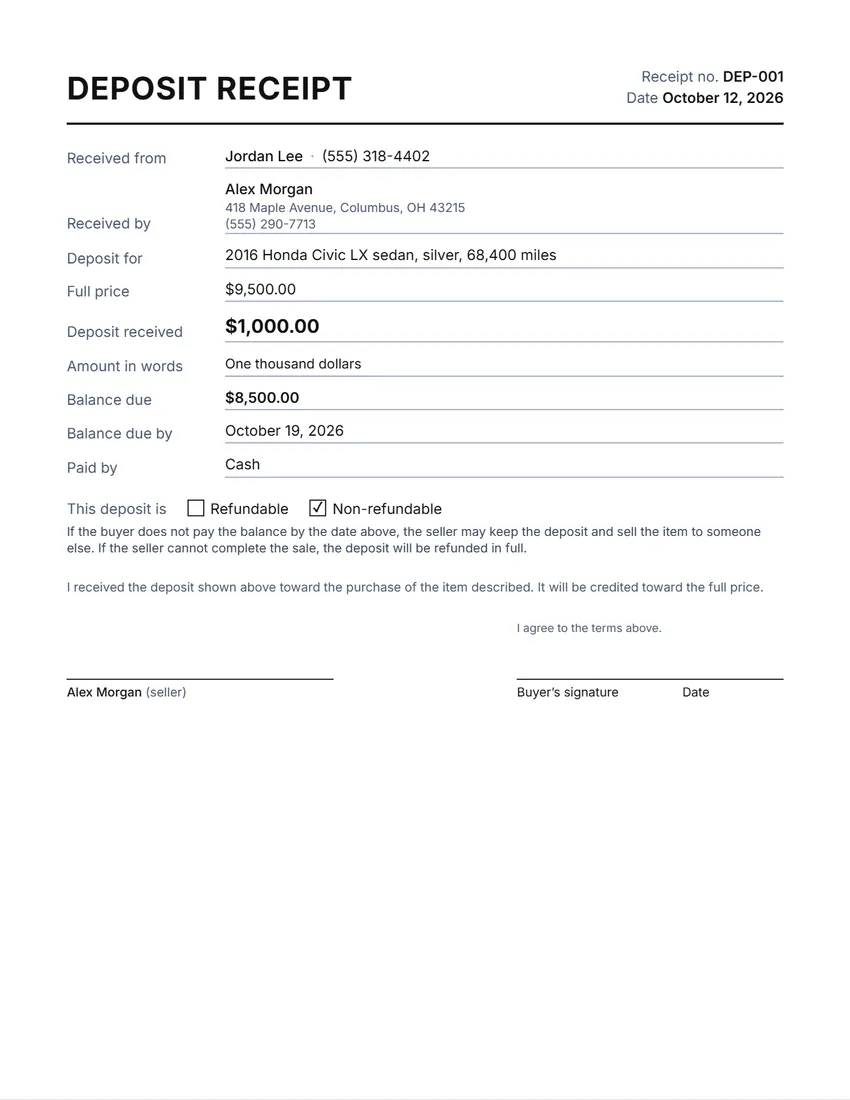 Default layout
BasicPlain labelled lines.
Start with this layoutOpen
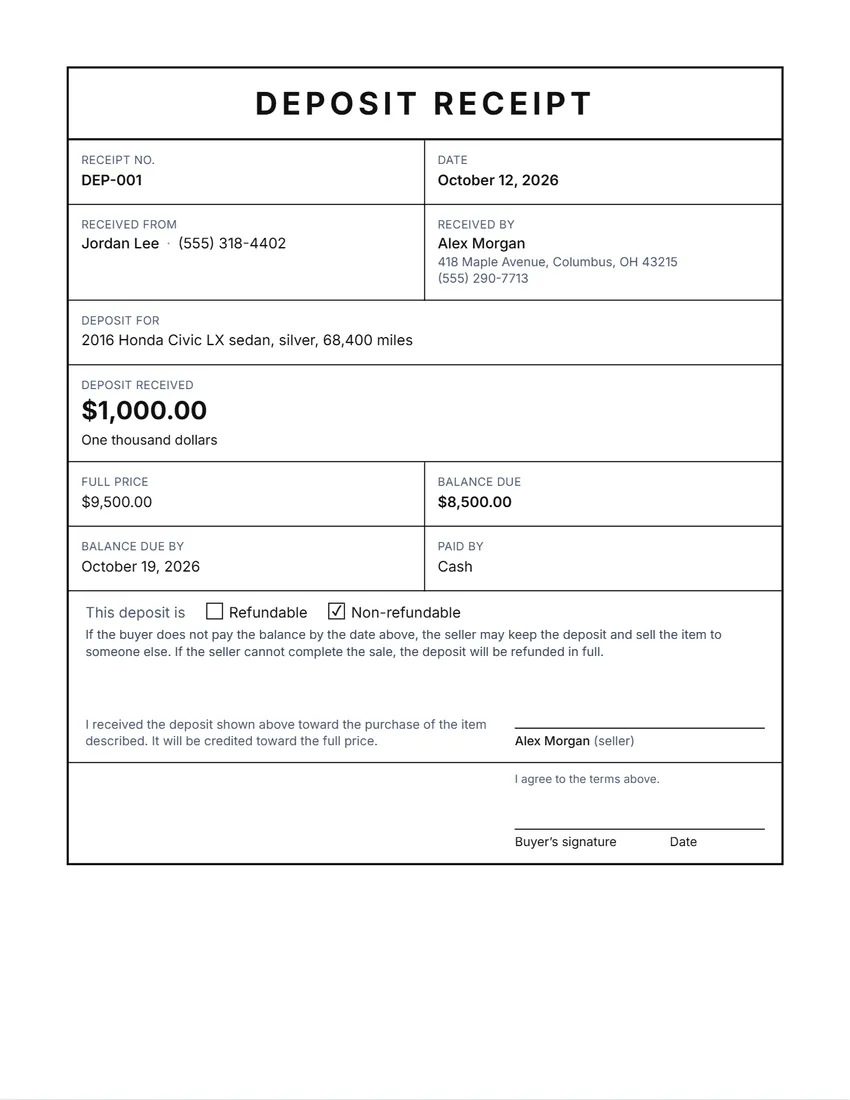 Layout
BoxedEverything in a ruled box, like a printed form.
Start with this layoutOpen
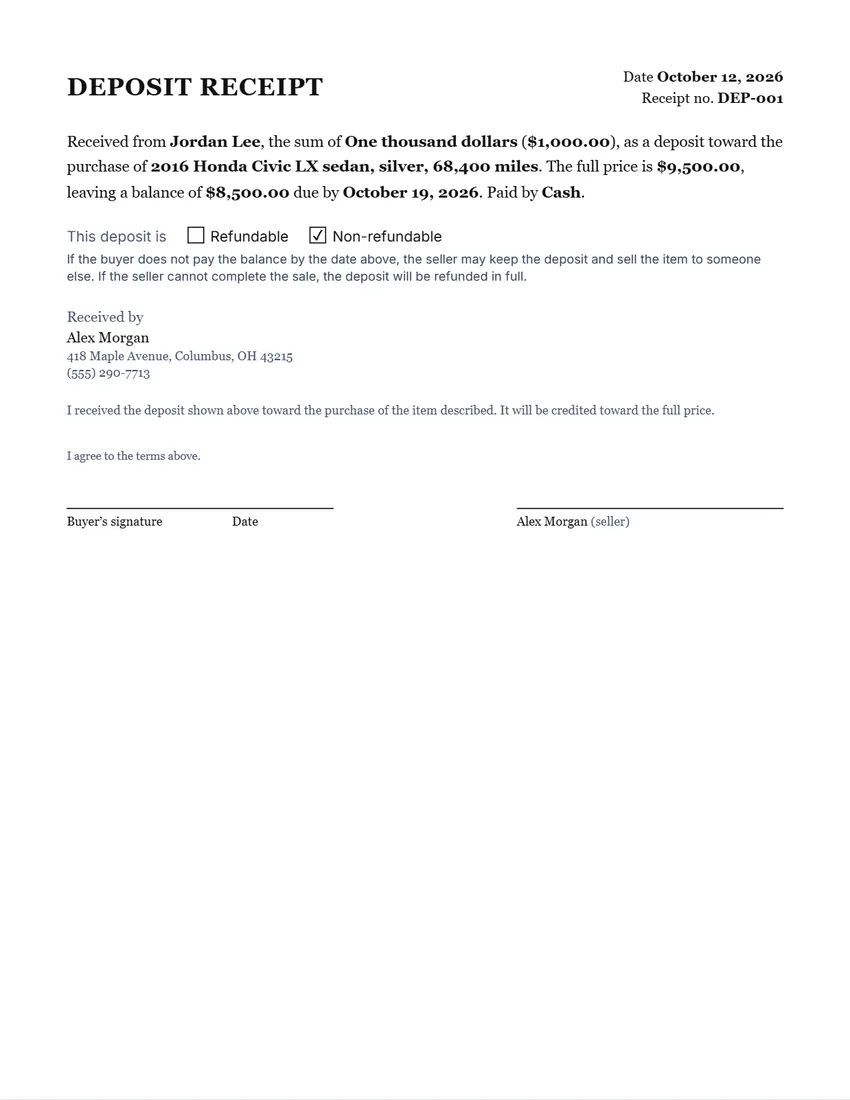 Layout
LetterWritten as a short formal paragraph in a serif typeface.
Start with this layoutOpen
Prefer to fill it in by hand? Print a blank template and write on it.
Related tools
Goes well with this one
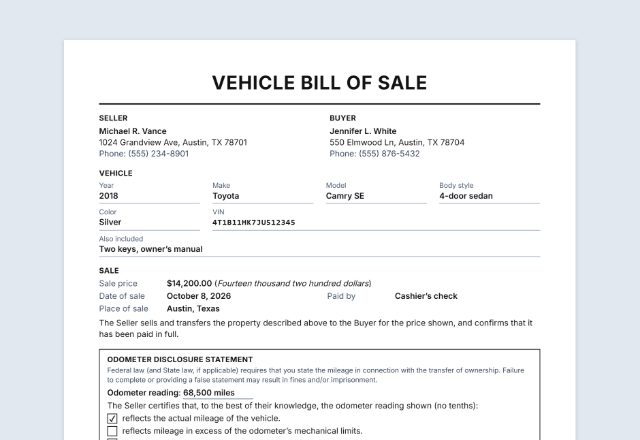 Bill of saleBuyer paid the balance?Open
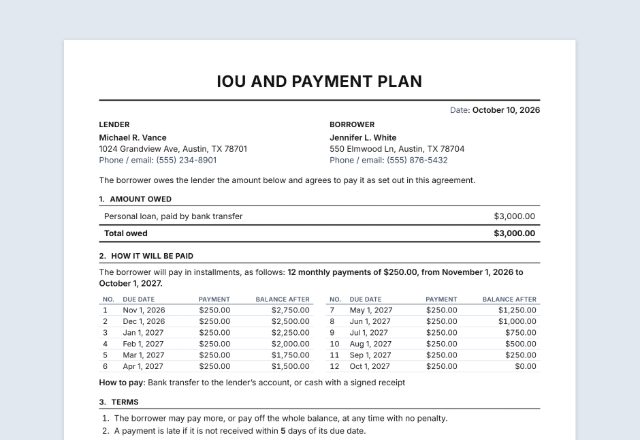 Payment plan / IOUPaying the balance in parts?Open
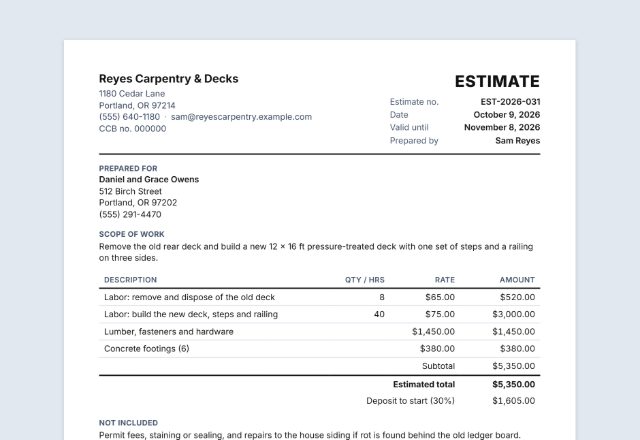 Job estimate / quoteTaking a deposit for a job?Open
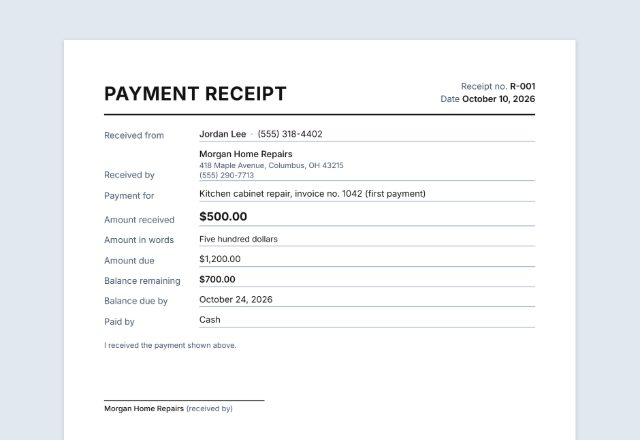 Payment / cash receiptBuyer paid the balance?Open
 Car for sale signSelling a car?Open
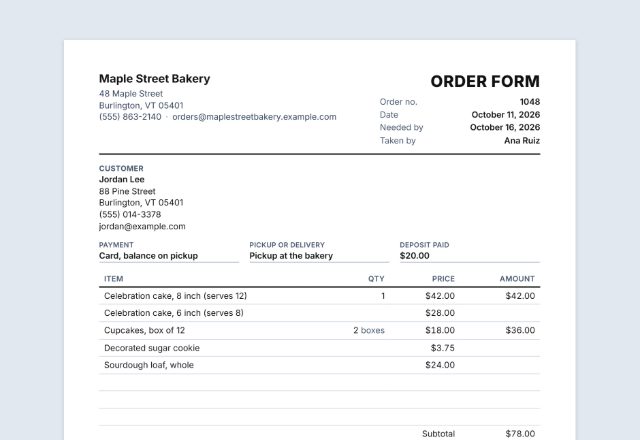 Order formTaking a custom order?Open
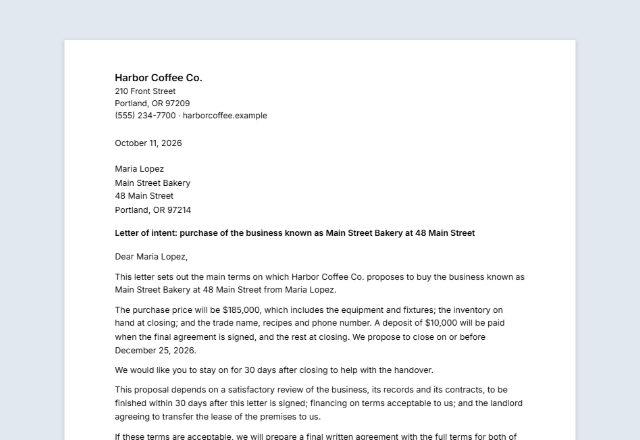 Letter of intentAgreeing the terms first?Open
Was this tool useful?
Notice: Generated via SnapPaperwork. For genuine deposits only. A receipt for money that was not paid, or with a false amount or item, can be illegal.
Something missing? Tell me what you need.
What is a deposit receipt?
A deposit receipt confirms that you received money toward a purchase or a service. It names the buyer and the seller, the item, the amount paid, the balance and whether the deposit can be refunded. Both sides should keep a copy.
How to write a deposit receipt in 3 steps
-
Describe the deal
Who paid, who received the money, and what the deposit is for, described so there is no doubt which item it is: make, model, colour, serial number or VIN.
-
Fill in the amounts and the terms
The deposit (written out in words automatically), the full price and the date the balance is due. Then tick Refundable or Non-refundable; the matching terms are printed under the box.
-
Sign, print, keep a copy
Sign on screen or on paper, print two copies on one page if you like, and have the buyer sign too. Each of you keeps a copy until the sale is done.
What a deposit receipt should include
- A receipt number and the date the deposit was paid.
- The names of the buyer and the seller, and a way to reach each other.
- What the deposit is for, described clearly enough to tell it apart from anything similar.
- The deposit in figures and in words, and how it was paid (cash, check, transfer).
- The full price, the balance still to pay, and the date it is due.
- Whether the deposit is refundable, and what happens if either side backs out.
- The seller’s signature, and ideally the buyer’s too, agreeing to the terms.
Refundable or non-refundable?
A refundable deposit comes back to the buyer if the sale does not go ahead. A non-refundable deposit is usually kept by the seller if the buyer walks away, because the seller held the item and turned other buyers down.
Even a “non-refundable” deposit is normally returned if the seller is the one who cannot complete the sale. And in some places a seller cannot keep more than a reasonable amount, whatever the receipt says. Write the terms you both agreed, in plain words, and keep the deposit small compared with the price.
Not sure? Tick neither box on screen and decide together, then tick the box by hand on the printed receipt.
Tips for taking a deposit
- Put the deal in writing before any money changes hands, and give the buyer a receipt at once.
- For a car, write the VIN; for an animal, a description and any microchip number; for a custom order, a short spec.
- Agree on a balance date and stick to it: the receipt says what happens if it passes.
- For cash, count it together. For a check, wait until it clears before you hand over the item.
- Hand over the item only when the balance is paid, and give a final receipt or bill of sale for the full price.
When the balance is paid, write a bill of sale for a car, boat or other item, and mention the deposit in it.
This page is general information, not legal advice. Whether a deposit can be kept depends on what you agreed and on the law where you live.
Frequently asked questions
Is this deposit receipt generator free?
Yes. It is free to use, needs no account or sign-up, and never adds a watermark or a SnapPaperwork logo to your receipt.
What is the difference between a deposit and a down payment?
People often use the words for the same thing: money paid now and taken off the full price later. A deposit is usually paid to hold an item until the buyer pays the rest. Either way, this receipt records the amount, what it is for and the balance still to pay.
Can a seller keep a non-refundable deposit?
Usually, if the buyer backs out and the terms said so. But it depends on what you agreed and on the law where you live; a seller who cannot complete the sale should normally give it back. This page is not legal advice.
Does the buyer need to sign?
It is a good idea. The seller signs to confirm the money was received; the buyer signs to agree to the terms, such as the balance date and whether the deposit is refundable. Untick the buyer’s line if you only need a simple receipt.
Is this a security deposit receipt for a rental?
No. This receipt is for a deposit toward buying something. For a rental, use the Security Deposit Receipt Generator, which has the wording a landlord needs.
Is my information uploaded or stored on your servers?
No. Everything you type stays in your browser and is never sent to me. The form and your signature are saved on your own device so they are there next time.
How do I print two copies?
Tick “Two copies on one page” (Basic, Letter and Register slip layouts) and cut along the dashed line: one copy for the buyer, one for the seller.