Free Commercial Invoice TemplateFill in the form, check the preview, then print it or save it as a PDF for your shipment. No sign-up, and nothing you type is uploaded.
Layout
Whole page · the printed page has no watermark or logo.
This commercial invoice is longer than one page and will print on two pages. Shorten the descriptions or notes, remove empty lines, or try another layout.
Examples3 layouts filled in with made-up details. Open one to start with that layout, or print a blank template to fill in by hand.
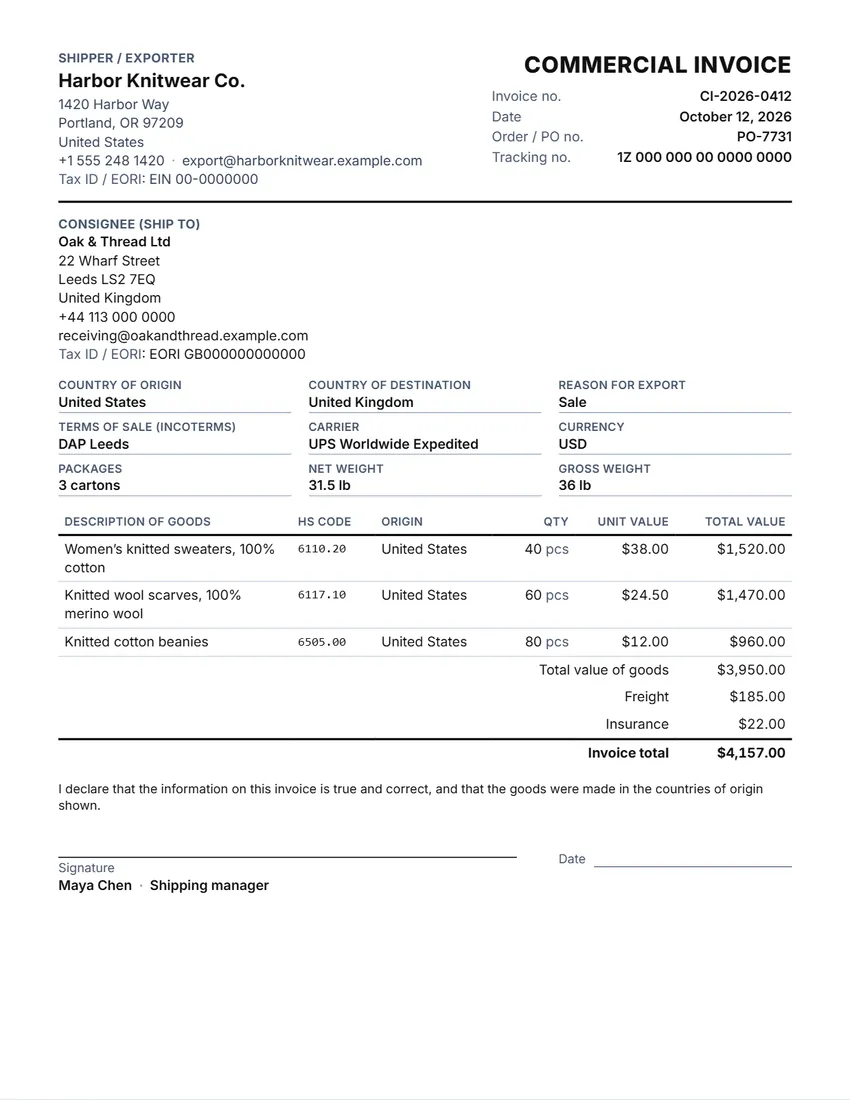 Default layout
ClassicYour logo and details at the top, the title and invoice number on the right.
Start with this layoutOpen
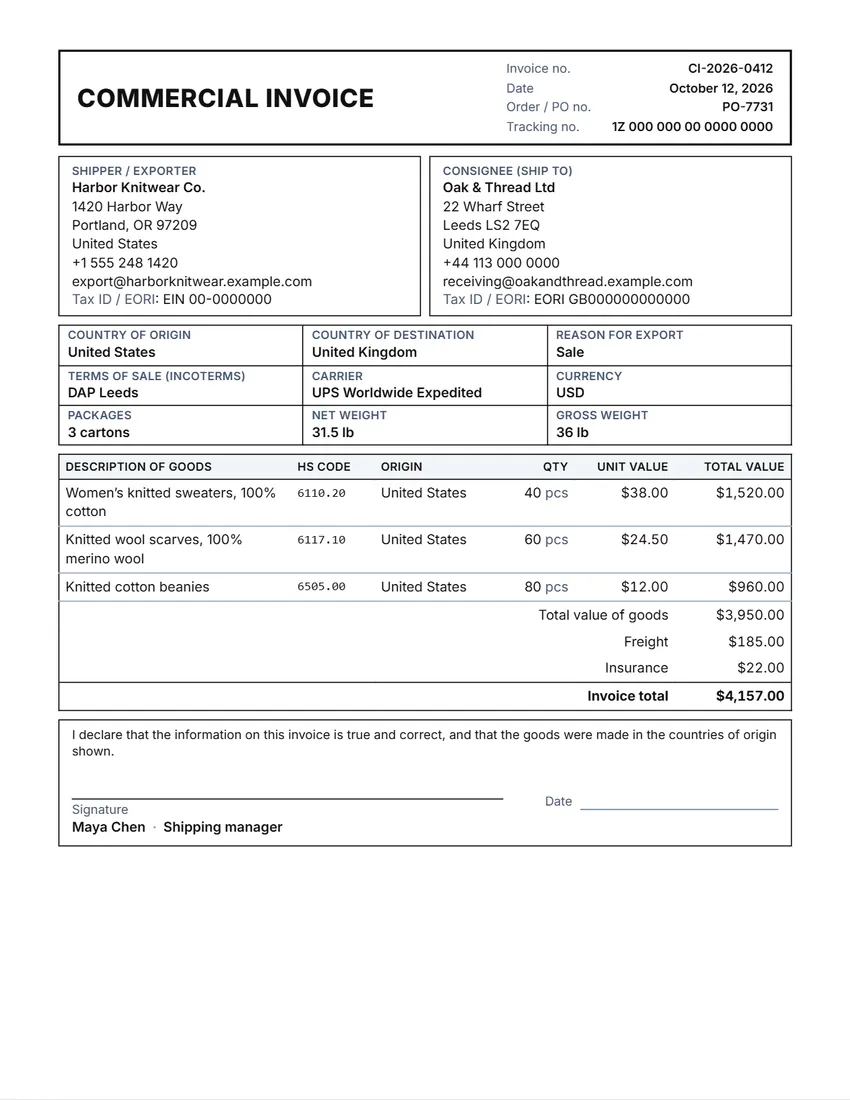 Layout
BoxedRuled boxes like a printed customs form.
Start with this layoutOpen
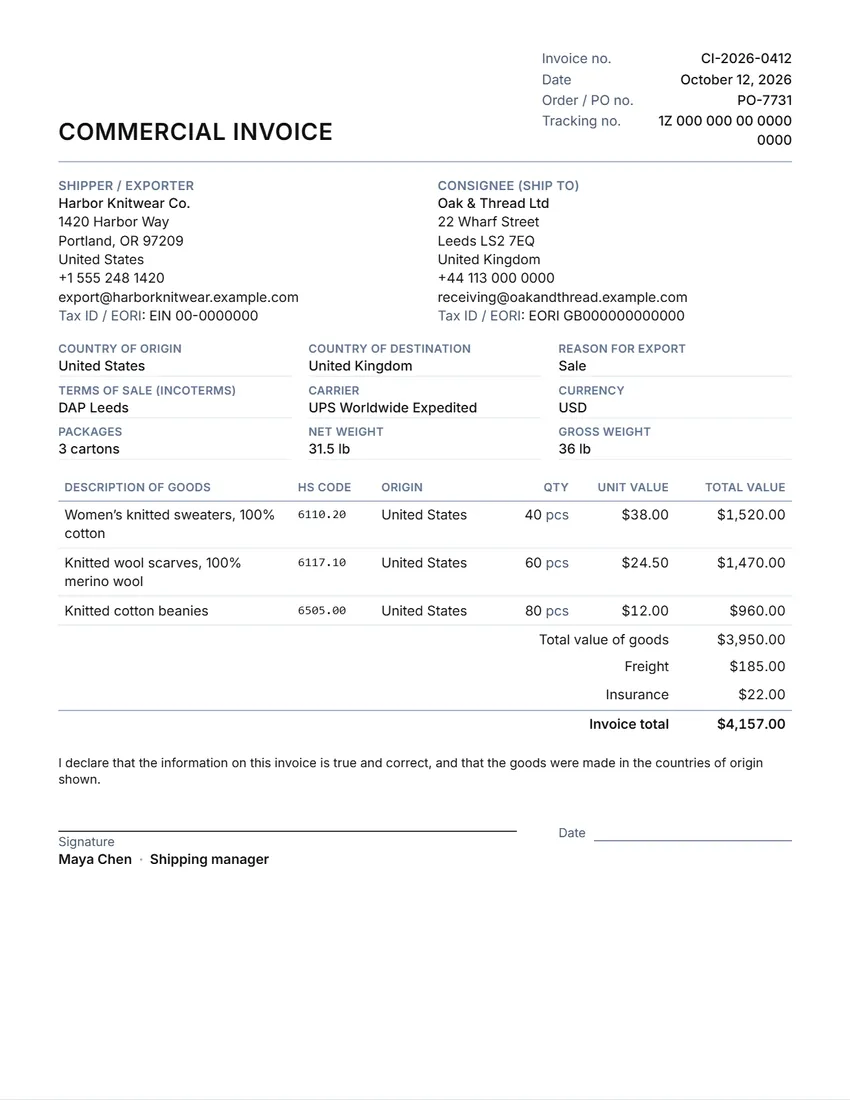 Layout
SimpleClean and light: thin lines, little ink.
Start with this layoutOpen
Prefer to fill it in by hand? Print a blank template and write on it.
Related tools
Goes well with this one
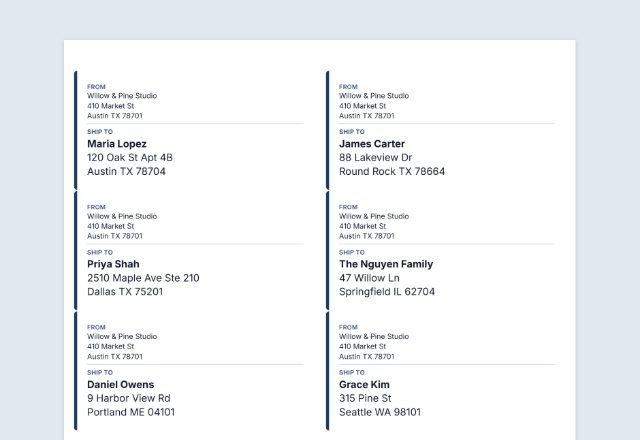
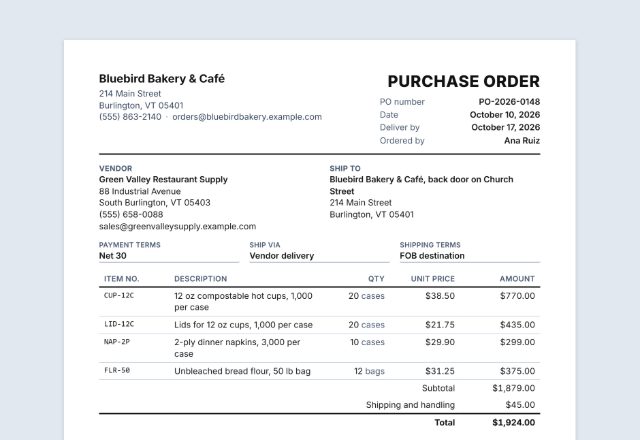
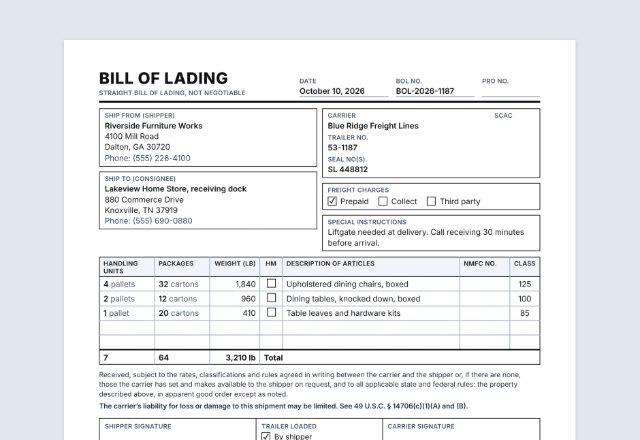
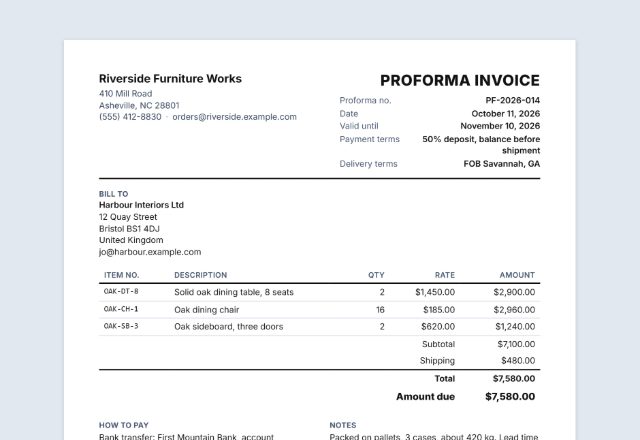
Was this tool useful?
Notice: Generated via SnapPaperwork. For real shipments only. A commercial invoice with a false value, description or country of origin can break customs law in both countries.
Something missing? Tell me what you need.
How to make a commercial invoice in 3 steps
-
Add the shipper and the consignee
You are the shipper (exporter). The consignee is who receives the goods. Include phone numbers, full addresses with the country, and tax or EORI numbers if you have them.
-
Describe the shipment and the goods
Country of origin and destination, reason for export, Incoterms, carrier, packages and weights. Then each item: a clear description, HS code, quantity and value. The totals are worked out for you.
-
Sign, print and attach
Sign the declaration, print three copies, put one in a document pouch on the box and give the others to the carrier as asked.
What a commercial invoice should include
- The shipper (exporter) and the consignee, with full addresses, phone numbers and tax or EORI numbers
- The buyer, if it is not the consignee
- Invoice number and date, and any order or PO number
- Country of origin and country of destination
- Reason for export (sale, gift, sample, return, repair) and the terms of sale (Incoterms)
- A clear description of each item, with its HS code, quantity, unit value and total value
- The currency, and any freight, insurance or other charges
- Number of packages, net and gross weight, and the carrier and tracking number
- A signed declaration that the information is true
Describing the goods and HS codes
Customs officers need to know exactly what is in the box. Say what each item is, what it is made of and what it is for: “Women’s knitted sweaters, 100% cotton”, not “clothing” or “gift”.
The HS (Harmonized System) code classifies the goods. The first 6 digits are the same in most countries; each country adds its own digits. US exporters can look up Schedule B numbers from the Census Bureau, US importers use the Harmonized Tariff Schedule, and UK traders use the UK Trade Tariff.
Give a value even for gifts, samples and returns: what the goods would sell for, in the currency shown. A shipment marked “no commercial value” with no value at all is often held.
Customs rules (US and UK)
Goods imported into the US: the invoice must show, among other things, the time, place and parties to the sale, a detailed description of each item, the quantities, the purchase price of each item and the currency, all charges such as freight, insurance and packing listed by name and amount, and the country of origin (19 CFR 141.86(a)). It must be in English or come with an English translation, and say what is in each package (141.86(d), (e)).
Exports from the US: for items on the Commerce Control List (not items classed EAR99, or shipped under License Exception BAG or GFT), the exporter must put the destination control statement on the commercial invoice (15 CFR 758.6). Tick it in the form to print the statement word for word.
US exporters also file Electronic Export Information (EEI) in the Automated Export System for many shipments. One common exemption is when the goods under each Schedule B number, to one consignee, are worth $2,500 or less (15 CFR 30.37(a)), but shipments that need an export license must be filed whatever their value (15 CFR 30.2(a)(1)(iv)).
The UK government’s guide lists much the same for an export invoice: invoice number and date, seller and buyer, the consignee, related order numbers, prices, currency and payment terms, quantities, weights and packages, HS codes with a plain description, Incoterms, package marks, the country of origin, transport details and the total value, plus charges such as freight and insurance.
Carriers (UPS, FedEx, DHL, postal services) have their own forms and rules too, and postal services often use a customs declaration (CN22 or CN23) instead. Check with your carrier.
Checked in October 2026. This page is general information, not legal or customs advice. Rules differ from country to country and change over time; your carrier or a customs broker can tell you what your shipment needs.
- 19 CFR 141.86: contents of invoices (eCFR)
- 15 CFR 758.6: destination control statement (eCFR)
- 15 CFR 30.37: exemptions from filing Electronic Export Information (eCFR)
- Schedule B export codes (US Census Bureau)
- Harmonized Tariff Schedule of the United States (US International Trade Commission)
- UK Trade Tariff: look up commodity codes (GOV.UK)
- How to create an export invoice (UK government, business.gov.uk)
Frequently asked questions
Is this commercial invoice generator free?
Yes. It is free to use, needs no account or sign-up, and never adds a watermark or a SnapPaperwork logo to your invoice.
What is a commercial invoice?
The invoice that travels with goods shipped to another country. Customs uses it to check what is in the shipment, where it was made and what it is worth, and to work out any duty and tax.
How many copies do I need?
Carriers usually ask for three signed copies: one in a document pouch on the outside of the package and the others with the shipping paperwork. Check with your carrier.
What is the difference between a commercial invoice and a proforma invoice?
A proforma invoice is sent before the sale or shipment, as a quote or so the buyer can arrange payment or an import license. The commercial invoice goes with the goods and shows the final details.
Do I need a commercial invoice for a gift?
Usually yes when it goes by courier: write “Gift” as the reason for export and give a fair value. Postal services may use a customs declaration form instead.
Where do I find the HS code?
Use your country’s tariff lookup: Schedule B from the US Census Bureau for US exports, the Harmonized Tariff Schedule for US imports, or the UK Trade Tariff. Links are in the guide above.
Is my information uploaded or stored on your servers?
No. Everything you type stays in your browser and is never sent to me. The form is saved on your own device so it is there next time.
How do I save the commercial invoice as a PDF?
Click “Print / Save PDF” and choose “Save as PDF” as the printer, or click “Download PDF” to save a file straight to your phone or computer. Many carriers let you upload the PDF when you book the shipment.