Free Promissory Note TemplateFill in the loan and the repayment schedule is worked out for you. Check the preview, then print it or save it as a PDF. No sign-up, and nothing you type is uploaded.
Layout
Whole page · the printed page has no watermark or logo.
This note is longer than one page and will print on two pages. Turn off the table of payments, the record of payments or the notary block, shorten the terms, or try another layout.
Examples3 layouts filled in with made-up details. Open one to start with that layout, or print a blank template to fill in by hand.
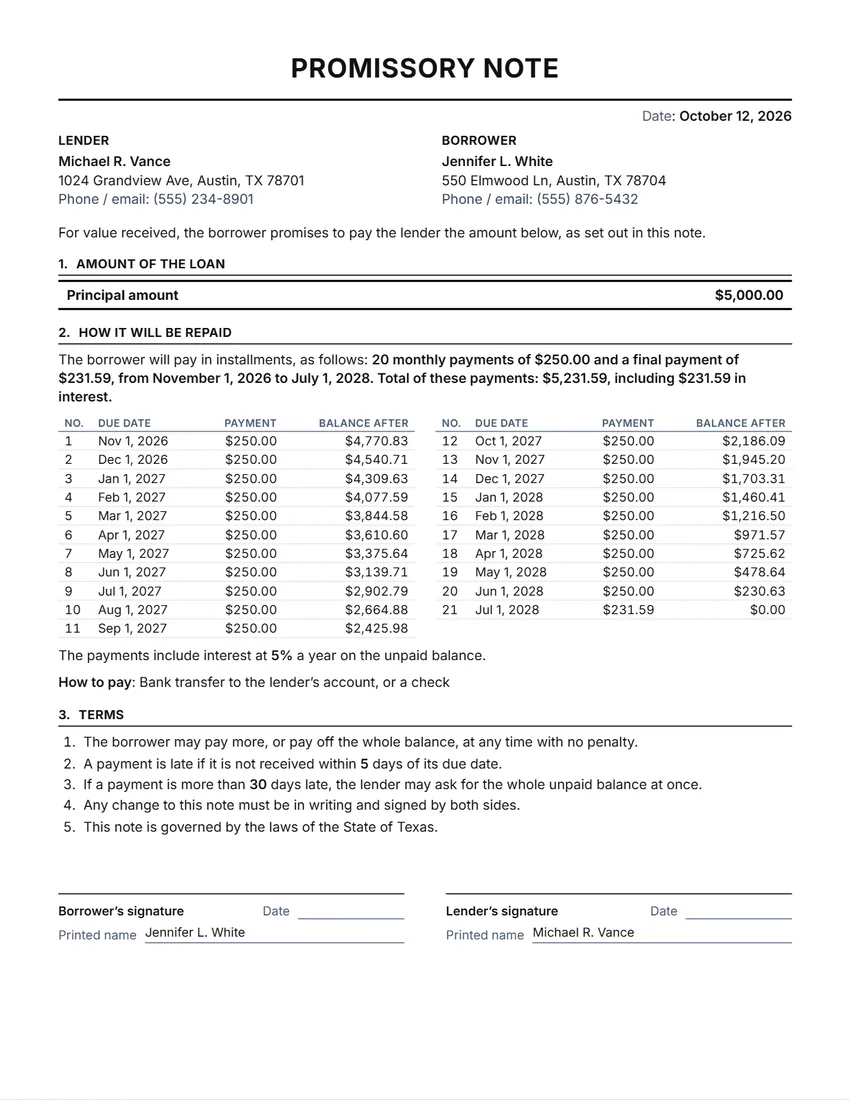 Default layout
ClassicCentred title, the two sides side by side, numbered sections and terms.
Start with this layoutOpen
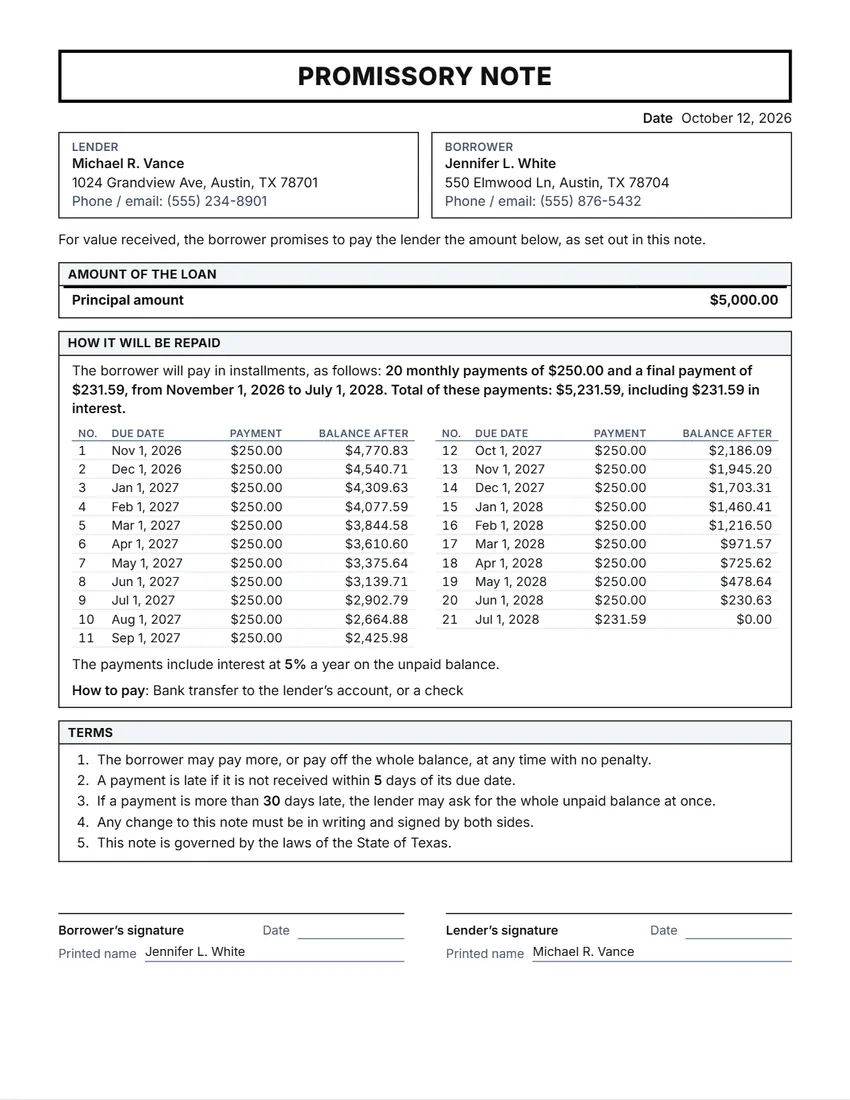 Layout
BoxedFramed title, ruled boxes and shaded section bars, like a printed form.
Start with this layoutOpen
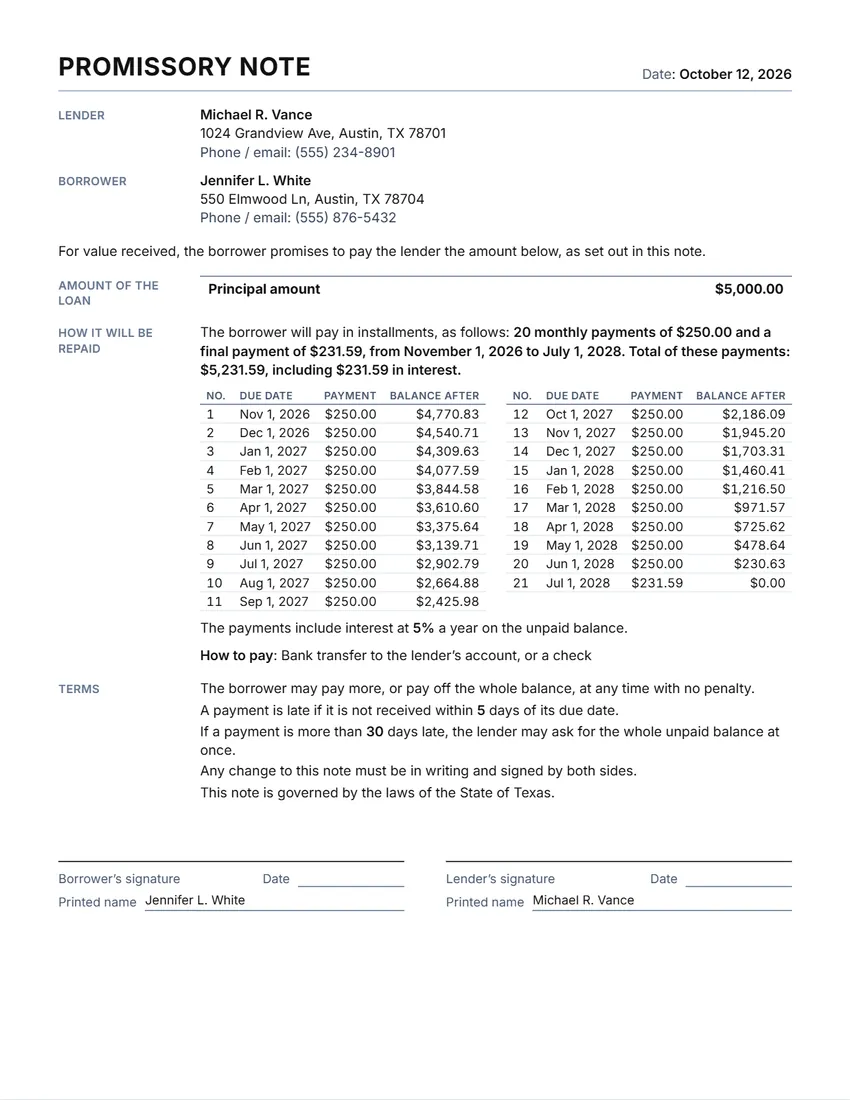 Layout
SimpleLight and ink-saving: labels beside values, no boxes.
Start with this layoutOpen
Prefer to fill it in by hand? Print a blank template and write on it.
Related tools
Goes well with this one
Was this tool useful?
Notice: Generated via SnapPaperwork. For real loans only. A note with a false amount or date, or signed for someone else without their permission, can be illegal.
Something missing? Tell me what you need.
How to make a promissory note in 3 steps
-
Enter the lender, the borrower and the amount
Who lends, who borrows, how much, and the date. Choose secured if property, such as a car, backs the loan.
-
Set how it will be repaid
One payment by a date, or installments every week, two weeks or month. Enter the amount of each payment, or the number of payments, and the schedule is worked out for you, with interest if you charge it.
-
Choose the terms, print and sign
Tick the terms you agree on (late payments, written notice, paying early, the whole balance due after a missed payment, a co-signer), then print it and sign. The lender keeps the original.
What a promissory note should include
- The names and addresses of the lender and the borrower, and the date
- The amount lent (the principal)
- The interest rate, if any, as a yearly rate
- How it will be repaid: one payment by a date, or the amount and date of each installment
- Where and how payments are made
- What happens if a payment is late: when it counts as late, any late fee, any notice, and whether the whole balance becomes due
- Whether the borrower may pay early without a penalty
- For a secured note, a clear description of the property pledged
- The borrower’s signature (and a co-signer’s, if there is one), with the date
Promissory note, IOU or loan agreement?
A promissory note is the borrower’s signed promise to repay a loan: how much, when, and with what interest. The borrower signs it, and the lender keeps the original until the loan is paid, then marks it paid and gives it back.
An IOU only says that money is owed, often without dates or terms. A loan agreement is a longer contract signed by both sides, with more promises from each. For a loan between people you know, a promissory note with a schedule is usually enough; for a large or business loan, ask a lawyer.
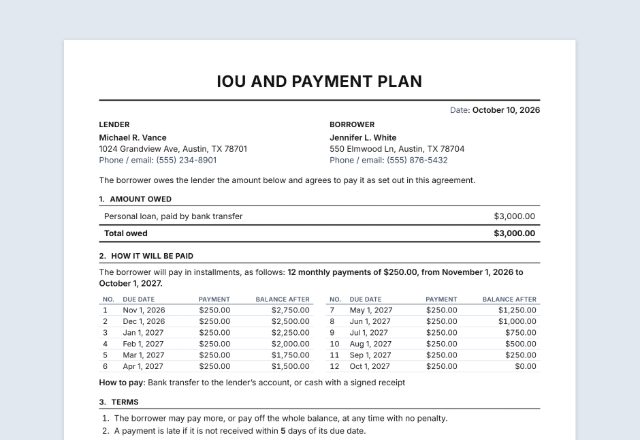
If someone owes you for rent, a bill or goods rather than a loan, the payment plan agreement fits better.
Interest and late fees
You do not have to charge interest. Leave “Charge interest” unticked and the note is interest-free.
If you do charge interest, most states set a maximum rate, often called a usury limit, and the limit can depend on the size and kind of loan and on who is lending. For example, in Texas the maximum is 10 percent a year unless another law allows more (Texas Finance Code § 302.001), and in Florida it is the equivalent of 18 percent a year simple interest for loans up to $500,000 (Florida Statutes § 687.03). Charging more can be illegal: in Florida, rates above 25 percent are a crime (§ 687.071).
Late fees have limits too. The same Texas law lets a loan at 10 percent a year or less add a delinquency charge only on a payment at least 10 days late, of no more than 5 percent of the payment or $7.50, whichever is greater (§ 302.001(d)). Texas also allows 6 percent a year legal interest from the 30th day after an amount is due when no interest was agreed (§ 302.002).
Check the rules for your state, and keep any interest rate and late fee reasonable. This page is general information, not legal advice.
Secured or unsecured?
An unsecured note is backed only by the borrower’s promise. A secured note also pledges property, such as a car or equipment, that the lender may look to if the loan is not repaid.
Writing the property in the note is a start, but the rules for taking and keeping a security interest depend on the kind of property and the state or country. A vehicle lender usually has the lien recorded on the title, and for other property a filing with the state may be needed so the claim stands against others. Ask a lawyer or the motor vehicle office before relying on it.
Tips for both sides
- Print it and have the borrower sign; the lender keeps the original. Make a copy for the borrower.
- Pay in a way that leaves a record (bank transfer, check). If cash changes hands, write a receipt each time.
- Tick “Record of payments” to add lines at the bottom for writing down each payment.
- When the loan is paid in full, the lender writes “Paid in full”, dates and signs the note, and gives it back to the borrower.
Checked in October 2026. This page is general information, not legal or tax advice. Rules differ from state to state and change over time.
- Texas Finance Code § 302.001 and § 302.002: interest rates (Texas Legislature)
- Florida Statutes § 687.03: unlawful rates of interest (Florida Senate)
- Florida Statutes § 687.071: criminal usury (Florida Senate)
- IRS Publication 550: Investment Income and Expenses (below-market loans)
- 26 U.S.C. § 7872: below-market loans (US Code, govinfo)
Frequently asked questions
Is this promissory note generator free?
Yes. It is free to use, needs no account or sign-up, and never adds a watermark or a SnapPaperwork logo to your note.
Who signs a promissory note?
The borrower signs it, because it is their promise to pay. Many people have the lender sign too, so both agree to the terms; this note has lines for both, and for a co-signer or witness if you add them.
How is the repayment schedule worked out?
Enter the amount of each payment, and the schedule runs until the balance is paid, with a smaller last payment if needed. Or enter the number of payments, and the loan is split into equal payments (rounded to the cent, the last one taking the difference). Each row shows the date, the payment and the balance left.
How is interest worked out?
As a yearly rate on the unpaid balance. Each payment first pays the interest for its period, and the rest pays down the balance. The note shows the total of all payments and how much of it is interest.
Do I have to charge interest on a loan to family or a friend?
Not on this form: leave interest off for an interest-free loan. In the US, tax rules for below-market loans can treat interest you did not charge as income and as a gift, but they do not apply on any day when the total of loans between two people is $10,000 or less, if the money is not used to buy or carry income-producing assets (26 U.S.C. § 7872(c)(2)). Ask a tax professional about larger loans or loans with a fixed term. For larger loans, ask a tax professional.
What is a secured promissory note?
One where the borrower pledges property, such as a car, as security for the loan. Choose “Secured by property” and describe the property. Taking a security interest can also need a filing or a lien on a title, so ask a lawyer or your motor vehicle office.
Does a promissory note need to be notarized or witnessed?
Usually not, but a witness or a notary can make it harder to dispute who signed. Tick “Witness” or “Notary block” to add them.
Is my information uploaded or stored on your servers?
No. Everything you type stays in your browser and is never sent to me. The form is saved on your own device so it is there next time. Signatures you draw are never saved.