Free Donation Receipt TemplateFill in the form, check the preview, then print it or save it as a PDF. No sign-up, and nothing you type is uploaded.
Layout
Whole page · the printed page has no watermark or logo.
This receipt is longer than one page and will print on two pages. Use fewer lines, shorten the descriptions or the wording, or try another layout.
Examples3 layouts filled in with made-up details. Open one to start with that layout, or print a blank template to fill in by hand.
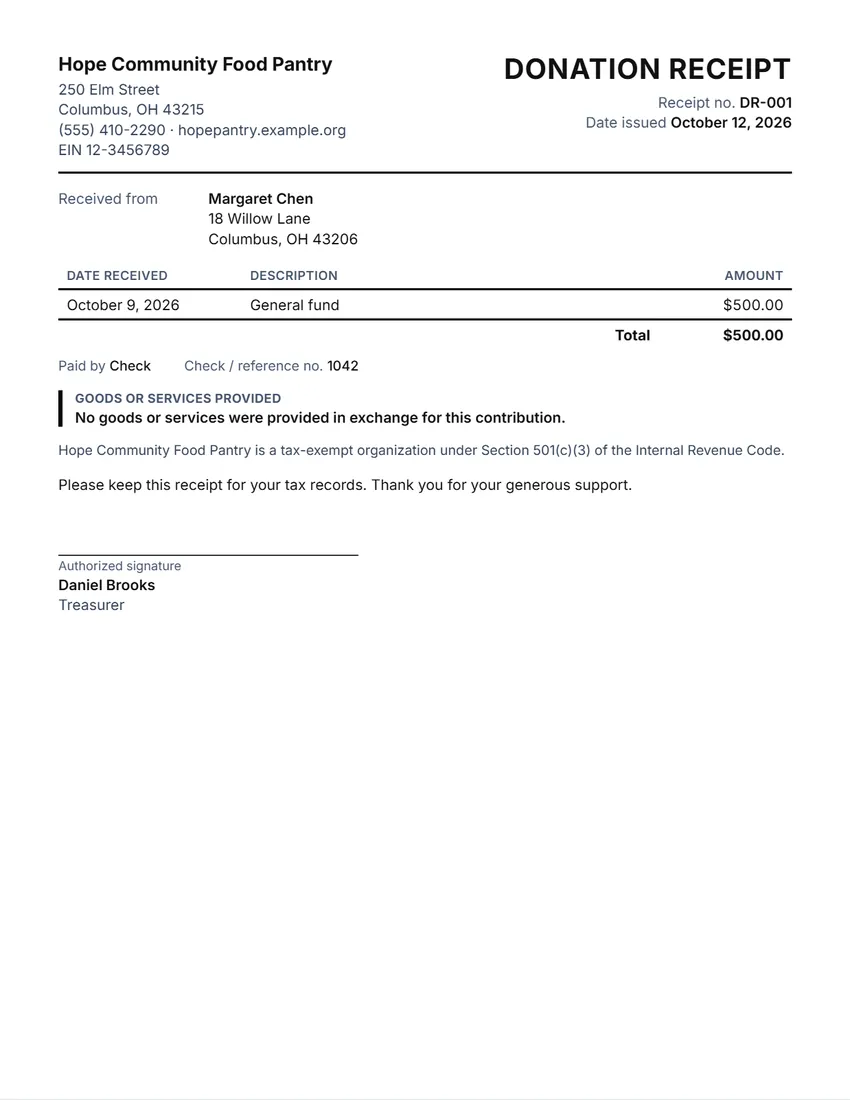 Default layout
ReceiptYour organization at the top, the gifts in a table.
Start with this layoutOpen
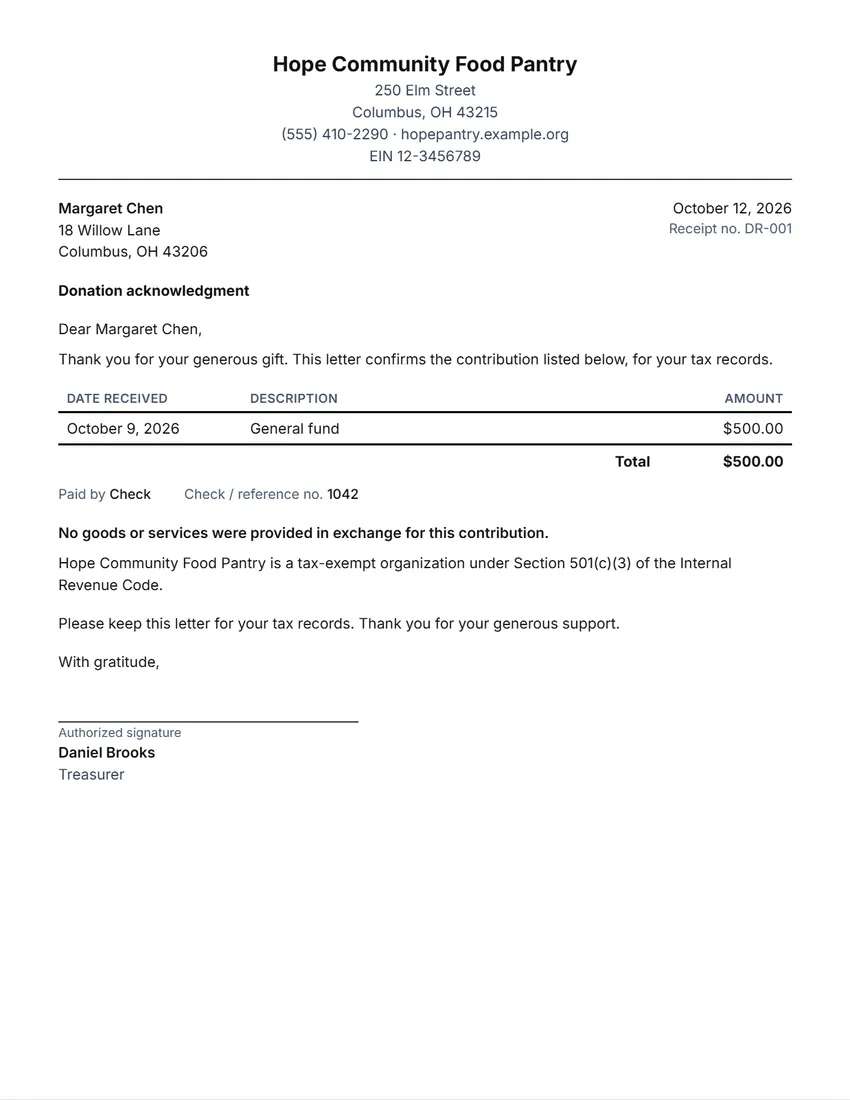 Layout
LetterA thank-you letter on your letterhead that doubles as the receipt.
Start with this layoutOpen
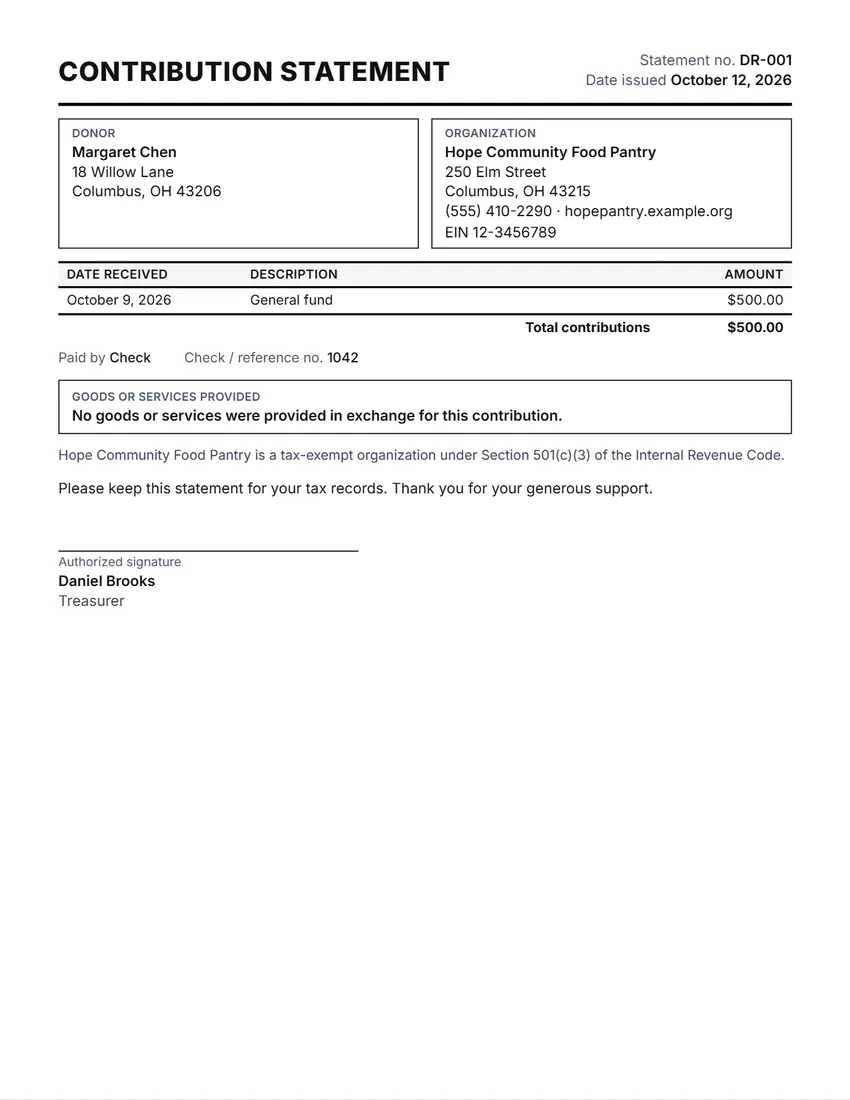 Layout
StatementYear-end giving statement: every gift of the period in one table.
Start with this layoutOpen
Prefer to fill it in by hand? Print a blank template and write on it.
Was this tool useful?
Notice: Generated via SnapPaperwork. For genuine donations only. A receipt for a gift that was not made, or with a false amount, date or description, can be tax fraud.
Something missing? Tell me what you need.
What is a donation receipt?
A donation receipt is a thank-you and a record that an organization received a gift. It names the donor and the organization, the date and the amount, or a description of donated goods. Give one for each gift, or one summary at the end of the year.
How to write a donation receipt in 3 steps
-
Fill in your organization and the donor
Your organization’s name and address (and EIN, if you like), then the donor’s name. Choose whether the gift was money or donated goods.
-
List the gifts and answer one question
Add each gift with the date you received it. Then say whether the donor got anything in return: the receipt prints the statement the IRS asks for.
-
Sign, give it to the donor and keep a copy
Print it, save a PDF or share it straight from your phone. Give it to the donor before they file their tax return, and keep a copy for your records.
When does a donor need a written receipt?
For any single gift of $250 or more, money or goods, the donor cannot claim a federal tax deduction without a written acknowledgment from your organization. Your organization is not penalized for not giving one, but the donor loses the deduction, so charities give one as a matter of course.
The donor must have it by the day they file their tax return for that year, or by the return’s due date (with extensions) if that comes first. Charities usually send them by January 31 of the next year.
You can give a receipt for each gift, or one statement for the year that lists them all. Gifts under $250 are not added together: weekly offerings of $50 each do not need a written acknowledgment, even if they add up to more than $250 over the year.
For a money gift of any size, the donor needs a record of it: a bank or card statement, a canceled check, or a written receipt from your organization showing its name, the date and the amount. A receipt from you covers that too.
What a donation receipt must include
For a gift of $250 or more, the IRS asks for a written acknowledgment with:
- The name of your organization
- The amount of any money given, with the date it was received
- A description of any goods or property given, but not their value
- A statement that no goods or services were given in return, if that was the case
- If goods or services were given in return, a description of them and a good-faith estimate of their value
- If the only thing given in return was an intangible religious benefit, a statement saying so
There is no IRS form for it. A letter, a postcard, an email or a printed receipt all work, as long as it has this information. The donor does not attach it to their tax return, but keeps it.
The goods or services statement
The donor can only deduct what they gave beyond the value of anything they got back. So the receipt has to say whether they got anything, and if so, what it was worth.
Small thank-you items do not count: a mug, a calendar or a tote bag with your logo is usually of “insubstantial value”, and the receipt can say no goods or services were given. The IRS sets the dollar limits for this each year.
When someone pays more than $75 and gets something back, such as $100 for a gala ticket whose dinner is worth $40, your organization must also tell them in writing that only the part above the value received is deductible (here, $60), with a good-faith estimate of that value. The IRS penalty for not doing so is $10 per contribution, up to $5,000 per event or mailing. Choosing “Yes: goods or services of value” in the form prints that statement.
| The donor received | What the receipt says |
|---|---|
| Nothing, or a small item with your logo | “No goods or services were provided in exchange for this contribution.” |
| Only intangible religious benefits, such as attending a service (religious organizations) | “No goods or services were provided in exchange for this contribution other than intangible religious benefits.” |
| A dinner, a ticket, a gift or another benefit | What it was, a good-faith estimate of its value, and that only the amount above that value is deductible |
Receipts for donated goods (in-kind gifts)
For clothing, furniture, food, equipment and other property, the receipt describes what was given, in enough detail to identify it (“3 bags of adult clothing, good condition”), but does not put a value on it. Valuing the items is the donor’s job.
If the donor claims more than $500 for noncash gifts, they also file Form 8283 with their return, and for an item worth more than $5,000 they need a qualified appraisal as well. Those are the donor’s steps, not the charity’s.
Cars, boats and airplanes worth more than $500 follow their own rules: the charity reports the gift to the IRS on Form 1098-C and has a set time to acknowledge it. Use IRS Publication 4302 for those, not this receipt.
New from 2026: a deduction without itemizing
From tax year 2026, people who take the standard deduction can still deduct up to $1,000 of cash gifts to qualifying charities, or $2,000 on a joint return. In most earlier years, only people who itemized could deduct gifts.
Only cash gifts count for this deduction (money given by cash, check, card or similar), not clothing, stock or other property, and gifts to donor-advised funds and supporting organizations do not qualify. More of your donors may now ask for a receipt, and the $250 written acknowledgment rule still applies.
Who can give a tax-deductible receipt?
Only gifts to qualified organizations are tax-deductible, such as charities recognized under Section 501(c)(3) and churches. Gifts to individuals are not deductible.
Donors can check whether an organization is eligible with the IRS Tax Exempt Organization Search. Churches that meet the 501(c)(3) requirements are tax-exempt without applying to the IRS, so a church may not be listed there, and gifts to it can still be deductible.
This tool follows US federal tax rules. Other countries have their own: Canada, for example, has official donation receipts with information set by the Canada Revenue Agency, and the UK uses Gift Aid declarations.
Checked in October 2026. This page is general information about US federal tax rules, not tax or legal advice. The rules and dollar limits change; for your own situation, ask a tax professional.
- Publication 1771: Charitable contributions, substantiation and disclosure requirements (IRS, PDF)
- Charitable contributions: written acknowledgments (IRS)
- Charitable contributions: quid pro quo contributions (IRS)
- Topic no. 506: Charitable contributions (IRS)
- Working Families Tax Cuts: the 2026 deduction for people who do not itemize (IRS)
- Publication 4302: A charity’s guide to vehicle donation (IRS, PDF)
- About Form 8283: Noncash charitable contributions (IRS)
- Tax Exempt Organization Search (IRS)
- Churches, integrated auxiliaries and conventions or associations of churches (IRS)
Frequently asked questions
Is this donation receipt generator free?
Yes. It is free to use, needs no account or sign-up, and never adds a watermark or a SnapPaperwork logo to your receipt.
Does a donation receipt have to be on an official IRS form?
No. There is no IRS form for it. A letter, postcard, email or printed receipt is fine as long as it has the organization’s name, the amount (or a description of donated goods) and the statement about goods or services given in return.
Do I need to give a receipt for gifts under $250?
It is not required for the written acknowledgment rule, but the donor still needs a record of any money gift: a bank record or a written receipt with your organization’s name, the date and the amount. Giving a receipt for every gift is simple and helps your donors.
Can I give one receipt for all of a donor’s gifts in a year?
Yes. A year-end statement that lists each gift, with its date and amount, works for the IRS. Choose the Statement layout, fill in the period, and add one line per gift (up to 12 lines on one page).
Should I put a value on donated clothing or furniture?
No. The receipt describes the items but does not value them. The donor decides the value when they file, and files Form 8283 if they claim more than $500 for noncash gifts.
What does “intangible religious benefits” mean?
Things a religious organization gives that are not usually sold outside a donation, such as attending a religious service. A church can state that only intangible religious benefits were given, without describing or valuing them.
A donor bought a gala ticket. What goes on the receipt?
Choose “Yes: goods or services of value”, describe what they received (for example, dinner for two) and give a good-faith estimate of its value. The receipt then says that only the amount above that value is deductible, and shows that amount.
Do I need to include the donor’s Social Security number?
No. The IRS says a written acknowledgment does not need the donor’s Social Security or tax ID number, and it is safer to leave it off.
Should the receipt include our EIN?
The IRS does not require it, but many charities print their EIN so donors and their tax preparers can identify the organization. Fill in the EIN box and it prints under your address.
Are the details I type uploaded or stored on your servers?
No. Everything you type stays in your browser and is never sent to me. Your organization’s details are saved on your own device so they are there for the next receipt. On a shared computer, press “Clear Form” when you are done.
How do I save the receipt as a PDF or email it?
Click “Print / Save PDF” and choose “Save as PDF” as the printer, or click “Download PDF” to save a file straight to your phone or computer. “Share” opens your device’s share menu with the PDF attached, for example to email it to the donor.