Free Bill of Lading TemplateFill in the form, check the preview, then print it for the driver or save it as a PDF. No sign-up, and nothing you type is uploaded.
Layout
Whole page · the printed page has no watermark or logo.
This bill of lading is longer than one page and will print on two pages. Remove empty lines, shorten the descriptions or instructions, or try another layout.
Examples2 layouts filled in with made-up details. Open one to start with that layout, or print a blank template to fill in by hand.
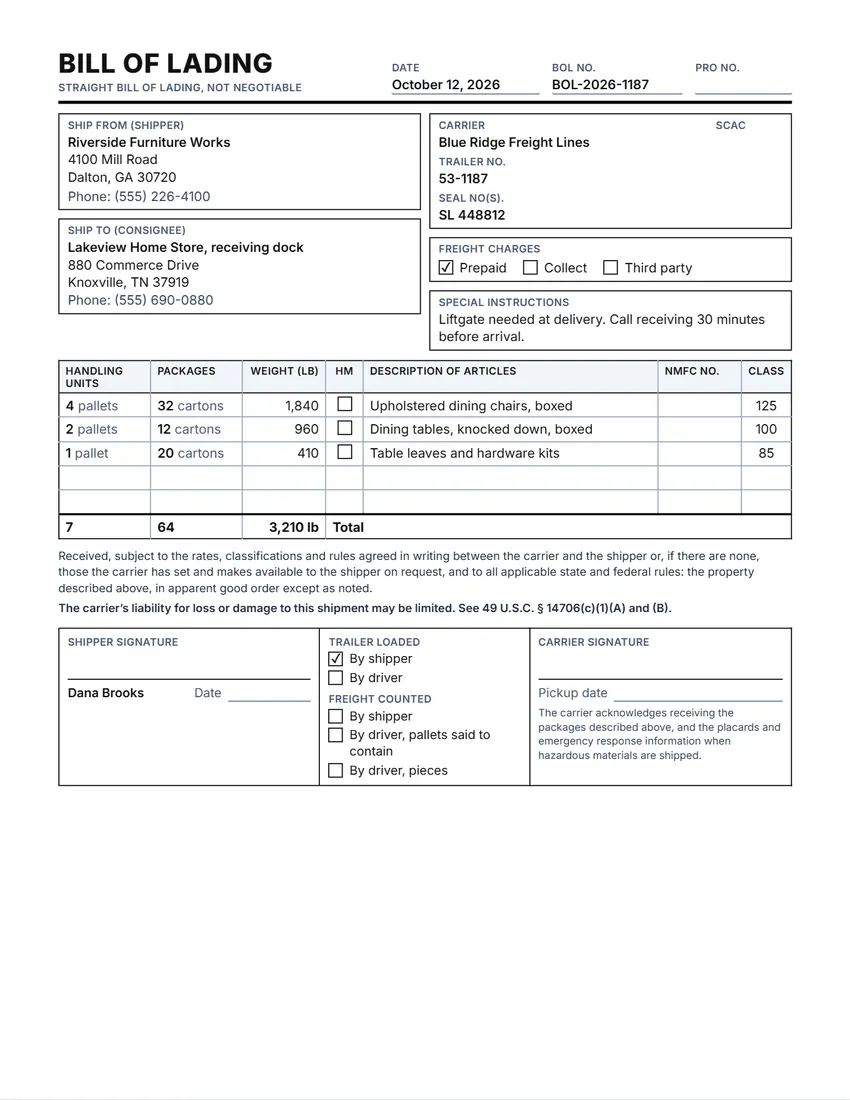 Default layout
StandardRuled boxes like the usual freight form.
Start with this layoutOpen
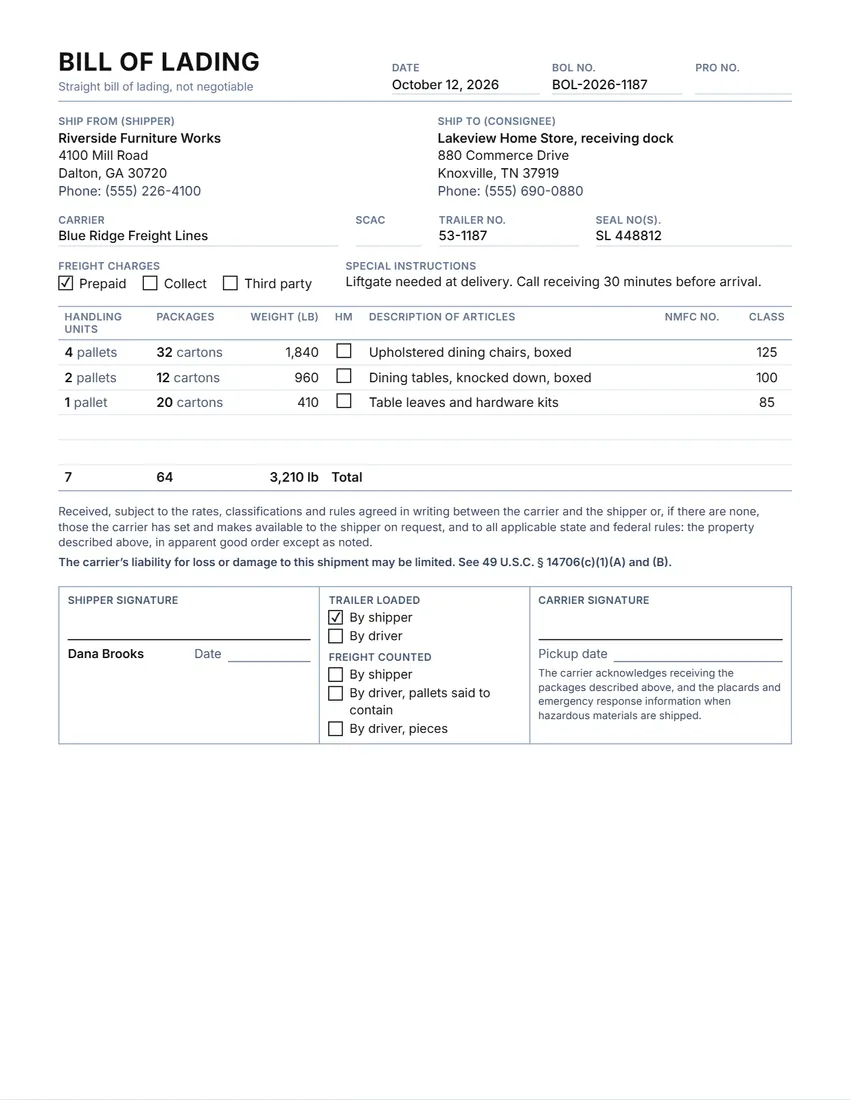 Layout
SimpleLighter: fewer boxes, thin grey lines.
Start with this layoutOpen
Prefer to fill it in by hand? Print a blank template and write on it.
Related tools
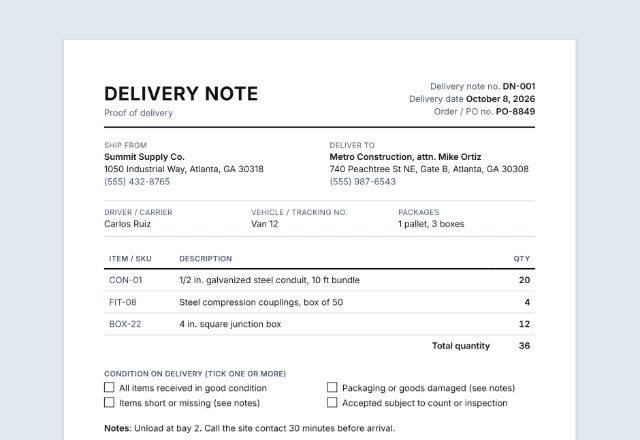
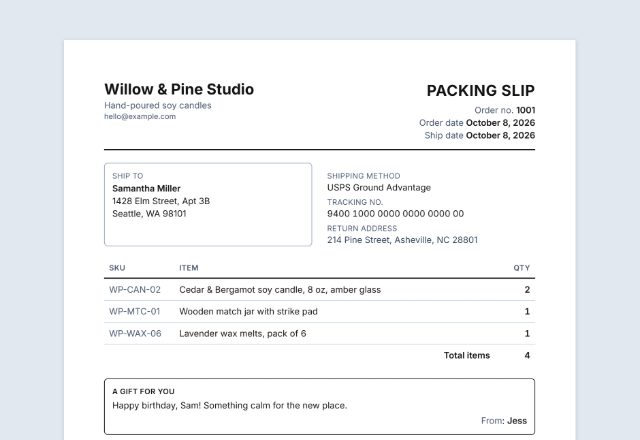
Goes well with this one
Was this tool useful?
Notice: Generated via SnapPaperwork. For real shipments only. A bill of lading with false weights, descriptions or signatures can be fraud, and hazardous materials must be described as the law requires.
Something missing? Tell me what you need.
How to make a bill of lading in 3 steps
-
Add the shipper, consignee and carrier
Who sends the freight, who receives it, and the carrier with the trailer and seal numbers. Choose who pays the freight charges.
-
List the freight
For each line: handling units and packages, weight, a description, and the NMFC number and freight class if you use them. The totals are added up for you.
-
Sign at pickup
Print copies, sign as the shipper, tick how the trailer was loaded and the freight counted, and have the driver sign the carrier box.
What a bill of lading should include
- The shipper (consignor) and the consignee, with addresses
- The origin and destination
- The number of packages and handling units
- A description of the freight
- The weight (and volume or size, when the rate depends on it)
- The carrier, trailer and seal numbers, and the date
- Who pays the freight charges: prepaid, collect or a third party
- Signatures of the shipper and the driver
Straight, order and master bills of lading
A straight bill of lading, like this one, names the consignee and cannot be transferred: the goods go to the person named. It is the usual form for freight within the US.
An order (negotiable) bill of lading can be endorsed to someone else, and is used mainly in international trade and for goods paid for through a bank. This tool does not make negotiable bills of lading.
A master bill of lading groups several shipments, and many carriers issue their own bill of lading or an electronic one when you book. You can use your own form if the carrier accepts it.
Liability, declared value and hazardous materials (US)
In the US, a for-hire motor carrier must issue a receipt or bill of lading showing at least the names of the consignor and consignee, the origin and destination, the number of packages, a description of the freight, and its weight, volume or measurement when that affects the rate (49 CFR 373.101).
Under federal law the carrier is liable for actual loss or injury to the property, and failing to issue a bill of lading does not change that (49 U.S.C. § 14706(a)). But a carrier may set rates under which its liability is limited to a value the shipper declares in writing or electronically, or agrees in writing, if that value is reasonable (§ 14706(c)(1)(A)), and must give the shipper its rates and rules on request (§ 14706(c)(1)(B)). Tick “Declared value” to add that line.
Hazardous materials need a full shipping description, the shipper’s certification (printed word for word: this tool does it when a line is marked HM) and an emergency response phone number that is monitored at all times the material is in transportation (49 CFR 172.204 and 172.604). If you ship hazardous materials, read the rules or ask your carrier before you ship.
Freight class (50 to 500) and NMFC numbers come from the National Motor Freight Classification, which many less-than-truckload carriers use to price freight. Ask your carrier which class applies, as a wrong class can mean a reclassification charge.
Checked in October 2026. This page is general information, not legal advice. Your carrier’s rules and rates apply to your shipment.
Frequently asked questions
Is this bill of lading generator free?
Yes. It is free to use, needs no account or sign-up, and never adds a watermark or a SnapPaperwork logo to your bill of lading.
What is the difference between a bill of lading and a packing slip?
A bill of lading is the contract and receipt between the shipper and the carrier, signed when the freight is picked up. A packing slip goes inside or on the boxes and lists what is in them for the person receiving the order.
What do prepaid, collect and third party mean?
Prepaid: the shipper pays the freight charges. Collect: the consignee pays. Third party: someone else pays, and the bill of lading names who to bill.
Who fills in the pro number and the carrier signature?
The carrier. The pro number is the carrier’s tracking number for the shipment, often a sticker the driver adds, and the driver signs the carrier box at pickup.
What does “Trailer loaded” and “Freight counted” mean?
They record who loaded the trailer and who counted the freight, which matters if there is a shortage later. Tick them on the page or in the form, or leave them for the driver to tick.
Can I ship hazardous materials with this form?
Mark the line HM and the page adds the shipper’s certification and an emergency phone line. You still need the full hazardous materials description and packaging the rules require, so check 49 CFR part 172 and your carrier’s requirements.
Is my information uploaded or stored on your servers?
No. Everything you type stays in your browser and is never sent to me. The form is saved on your own device so it is there next time.
How do I save the bill of lading as a PDF?
Click “Print / Save PDF” and choose “Save as PDF” as the printer, or click “Download PDF” to save a file straight to your phone or computer. “Share” opens your device’s share menu with the PDF attached.