Free Car Bill of Sale TemplateFill in the form, check the preview, then print it or save it as a PDF. No sign-up, and nothing you type is uploaded.
Layout
Whole page · the printed page has no watermark or logo.
This bill of sale is longer than one page and will print on two pages. Shorten the terms or the description, turn off the notary block, or try another layout.
Examples3 layouts filled in with made-up details. Open one to start with that layout, or print a blank template to fill in by hand.
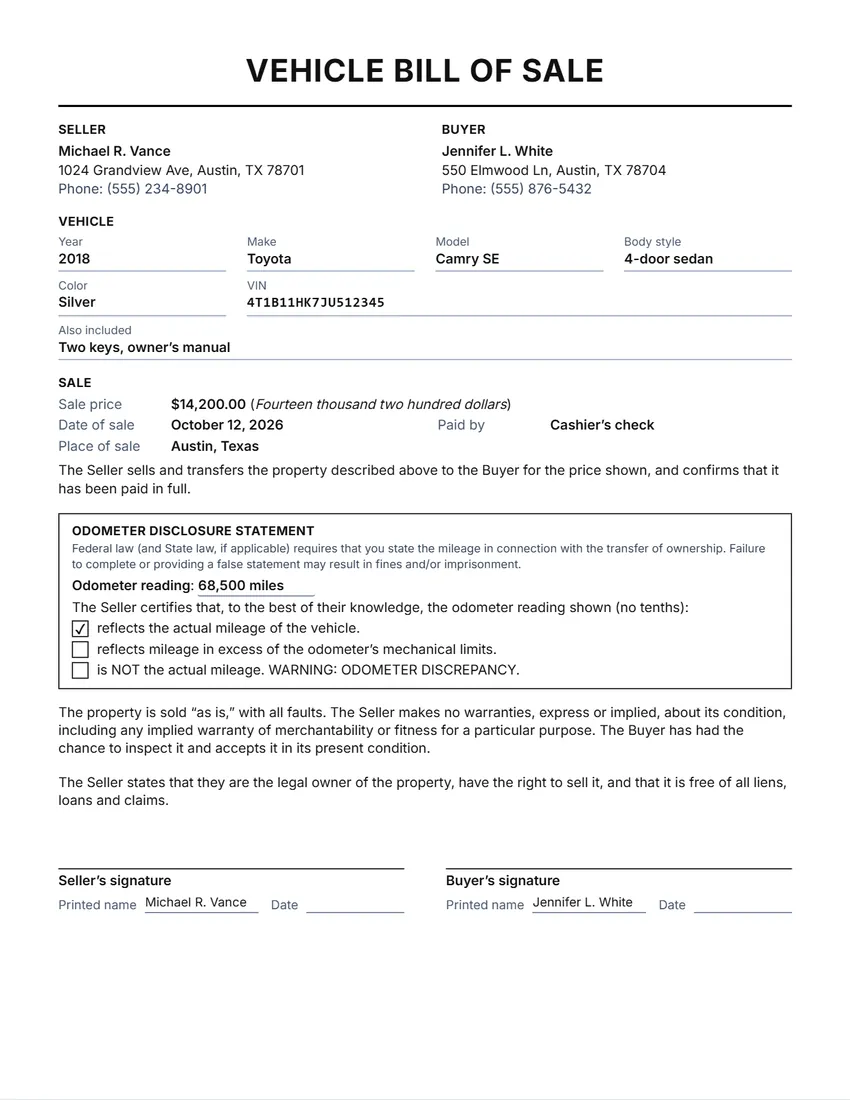 Default layout
ClassicCentred title, seller and buyer side by side, ruled lines for the property.
Start with this layoutOpen
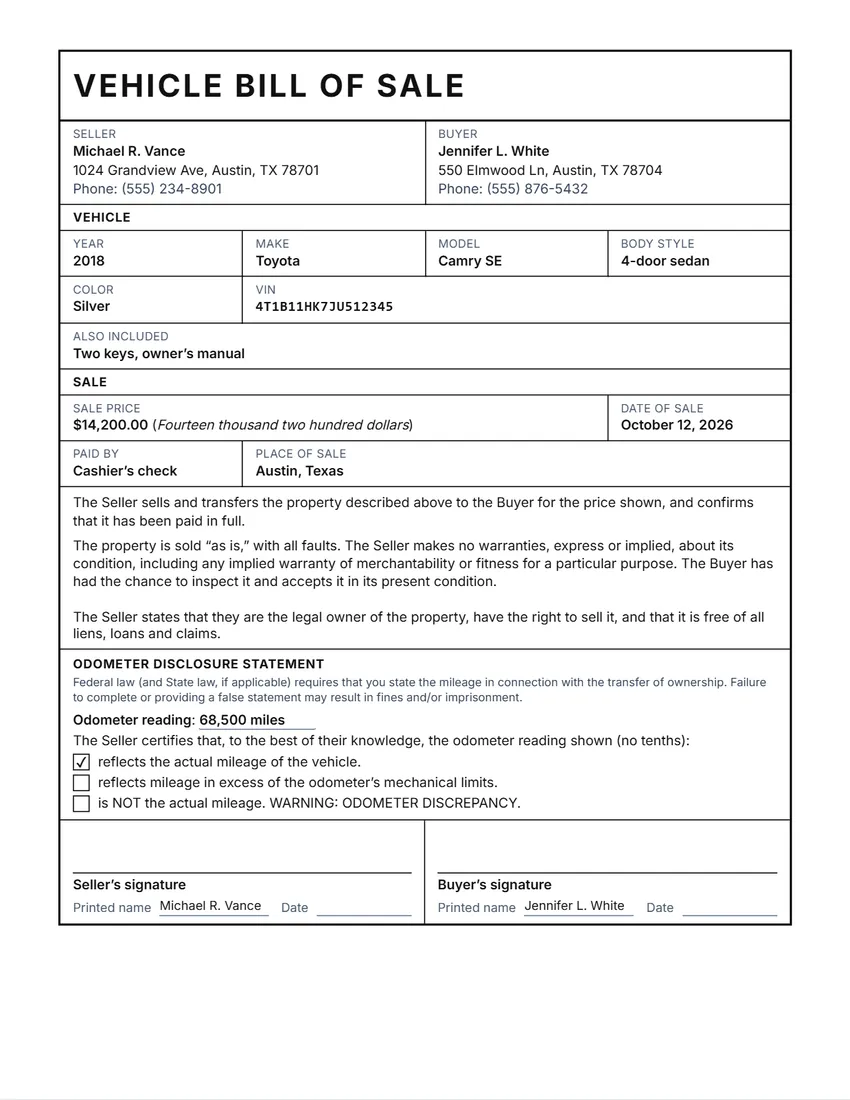 Layout
BoxedRuled boxes for every detail, like a printed office form.
Start with this layoutOpen
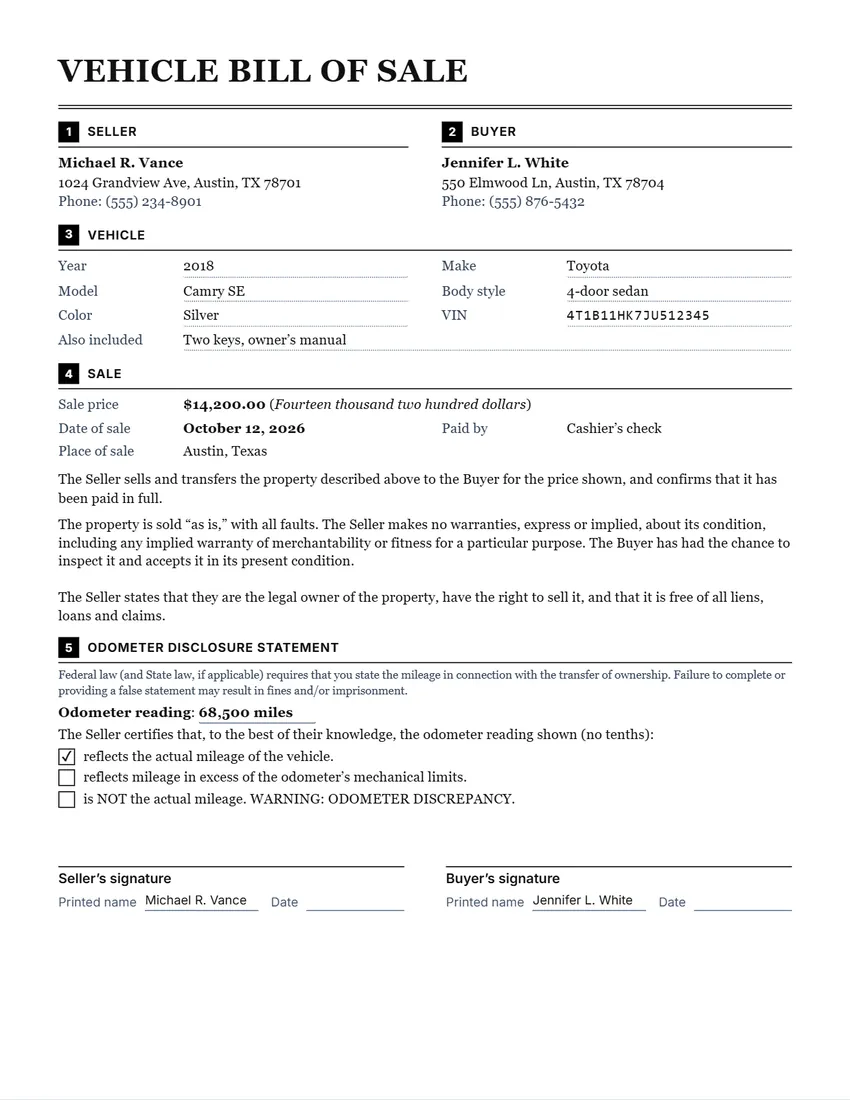 Layout
NumberedFormal numbered sections in a serif typeface, like a lawyer’s form.
Start with this layoutOpen
Prefer to fill it in by hand? Print a blank template and write on it.
More versions of this form
Related tools
Goes well with this one
Was this tool useful?
Notice: Generated via SnapPaperwork. For genuine sales only. A false bill of sale, a wrong price to lower sales tax, or a false odometer statement can be illegal.
Something missing? Tell me what you need.
How to make a car bill of sale
-
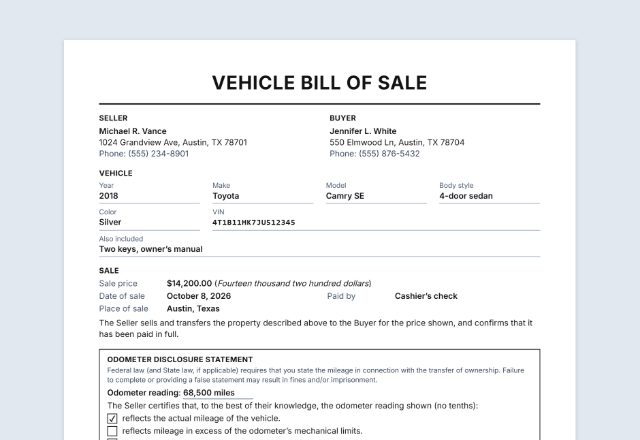
Describe the car
Year, make, model, body style and color, the 17-character VIN and the odometer reading. The VIN is checked as you type, so a typo shows up before you print.
-
Add the seller, the buyer and the price
Both names and addresses, the date, the price (written out in words for you) and how it was paid. The “as is” and “owned outright” clauses are on by default.
-
Print two copies and sign both
Each of you signs both copies and keeps one. Then sign the title over as well: the bill of sale records the deal, the title moves the ownership.
What a car bill of sale should include
- The full names and addresses of the seller and the buyer
- Year, make, model, body style and color of the car
- The VIN, exactly as it appears on the title and on the car
- The odometer reading on the day of the sale
- The price in figures and words, or “gift” if no money changes hands
- The date, how the buyer paid, and whether the car is sold “as is”
- Both signatures with printed names and the date
The bill of sale and the title
Ownership of a car passes through the certificate of title: the seller signs it over and the buyer applies for a new title and registration. A bill of sale does not replace the title, but many DMVs ask for one, for example to work out sales tax or when the title has no space for the price.
Some states have their own form, such as Florida’s HSMV 82050. If your DMV asks for its own form, use it and keep this one as your record. Many states also ask the seller to report the sale and decide what happens to the plates, so check your DMV’s website before the sale.
The odometer reading
US federal law requires the seller of a motor vehicle to state the mileage when ownership changes and to certify whether it is the actual mileage (49 CFR 580.5). It applies to vehicles of model year 2011 and newer, for 20 years; vehicles of model year 2010 and older are exempt (49 CFR 580.17).
The official statement is made on the title or on your state’s odometer form. The disclosure this tool prints for US cars is an extra record for both of you.
Before you hand over the keys
- Compare the VIN on the title with the VIN on the dashboard and the driver’s door frame. They must match.
- Buyers can order a vehicle history report built on NMVTIS, run for the US Department of Justice, to see title brands such as salvage or flood.
- Sellers: keep your copy, report the sale if your state asks, and call your insurer once the car is no longer yours.
- Meet in a safe public place and use a payment you can check, such as a cashier’s check confirmed with the bank.
Checked in October 2026. This page is general information, not legal advice. Rules differ from place to place and change over time.
- 49 CFR 580.5: Disclosure of odometer information (eCFR, National Archives)
- 49 CFR 580.17: Exemptions (eCFR, National Archives)
- UCC § 2-316 on excluding warranties, as enacted in Texas: Business & Commerce Code § 2.316 (Texas Legislature)
- NMVTIS: what a vehicle history report shows (US Department of Justice)
- Florida HSMV 82050: Notice of Sale and/or Bill of Sale (FLHSMV)
Frequently asked questions
Is a car bill of sale enough to transfer ownership?
No. Ownership passes when the seller signs the title over and the buyer registers the car. The bill of sale is the record of the deal that the DMV, the buyer and the seller may need alongside the title.
Does a car bill of sale need to be notarized?
In most states, no. A few states require it in some cases, and the rules change, so check your DMV. If you need one, turn on the notary block and sign in front of the notary.
What does “as is” mean on a car bill of sale?
The buyer takes the car in its present condition, with any faults, and the seller makes no promise about how it runs. Under the Uniform Commercial Code, words like “as is” exclude the implied warranties. It does not cover hiding a problem the seller knows about.
Can I use it for a car I am giving away?
Yes. Choose “Gift” instead of a price: the bill of sale then says no money was paid, which some DMVs ask for when working out tax.
Do I need to fill in the mileage?
For cars of model year 2011 and newer, US federal law requires the seller to state the mileage when ownership changes. The official statement goes on the title; the bill of sale keeps a copy for both of you.
Is this car bill of sale free?
Yes. It is free, needs no account and adds no watermark. What you type stays in your browser.