Free Ingredient & Food Label MakerType the food, its ingredients and the allergens it contains, then print a sheet of matching labels. No sign-up, and nothing you type is uploaded.
Design
Whole page · the printed page has no watermark or logo.
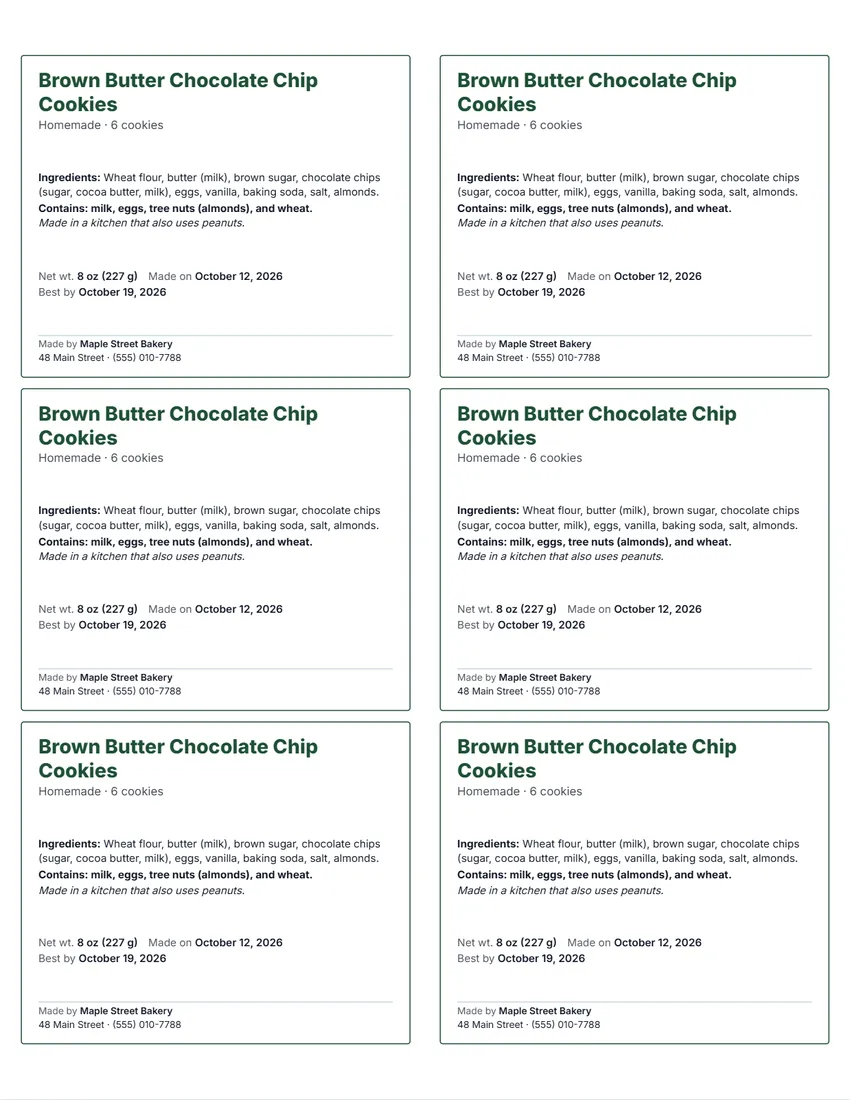
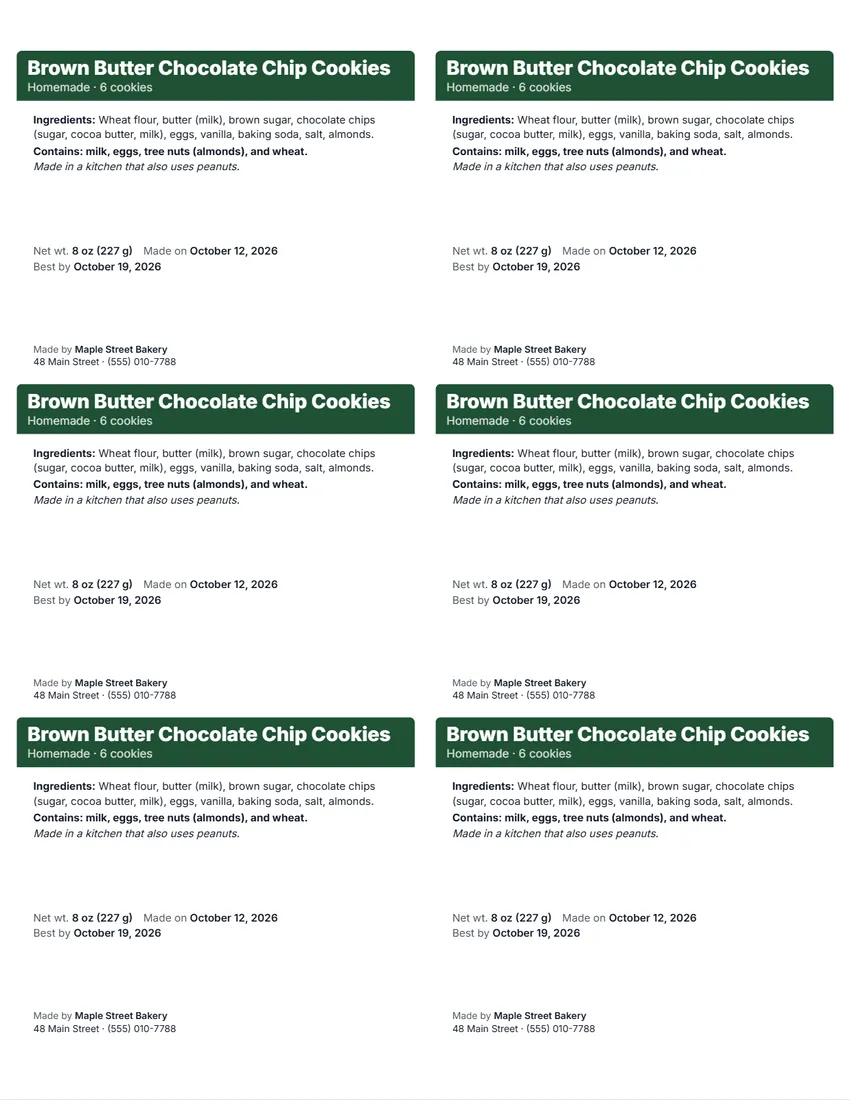
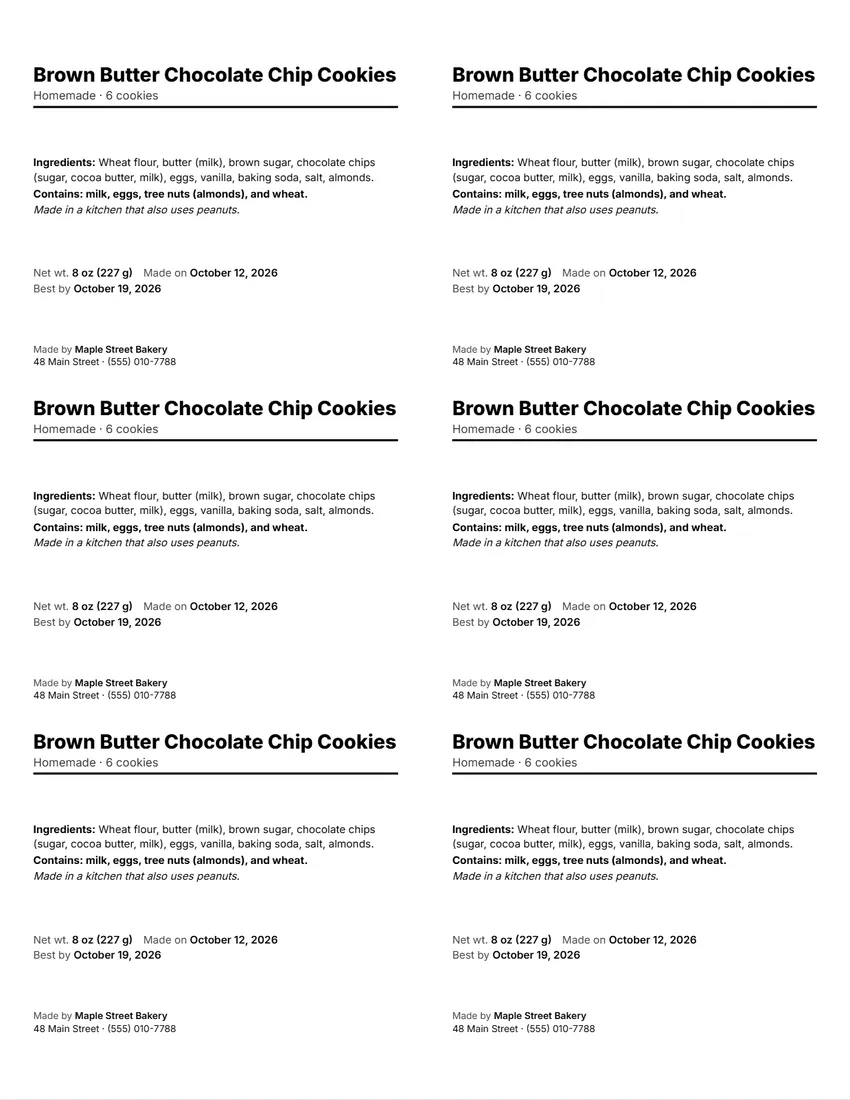
Examples3 layouts filled in with made-up details. Open one to start with that layout.
Related tools
Goes well with this one
Was this tool useful?
Notice: Generated via SnapPaperwork. For food you make. List every ingredient and allergen honestly: a wrong allergen label can make someone seriously ill.
Something missing? Tell me what you need.
What goes on a homemade food label?
A homemade food label usually shows the product name, the ingredients, the main allergens, the weight or amount, the date it was made or its best-by date, and who made it. Print it on label sheets and stick it on each jar, bag or box. Check what your area asks for before you sell.
How to make food labels in 3 steps
-
Describe the food
The product name, a line under it (“Homemade · 6 cookies”), the ingredients from most to least, and the net weight.
-
Tick the allergens
Tick each of the nine major food allergens it contains, and name the kind of tree nut, fish or shellfish. They print as “Contains: milk, eggs, and wheat.”
-
Dates, maker, print
Add the dates (or leave lines to write them on each batch), who made it, pick your label sheet and print a test page first.
Allergens on food labels
- The US Food and Drug Administration names nine major food allergens: milk, eggs, fish, crustacean shellfish, tree nuts, peanuts, wheat, soybeans and sesame (FDA: Food Allergies).
- On packaged food, the FDA asks for each one to be named either in the ingredient list, such as “whey (milk)”, or in a “Contains” line next to it, such as “Contains wheat, milk, and soy”. This tool prints a “Contains” line from the boxes you tick.
- For tree nuts, fish and crustacean shellfish, the kind is named too: almonds, cod, shrimp.
- A “may contain” or “made in a kitchen that also uses…” line is your own warning; the tool prints it under the allergens if you add one.
Selling food made at home
- Many US states let people sell some foods made in a home kitchen (“cottage food”), with rules on what can be sold, where, and what the label must say.
- Those label rules often include a set sentence, the maker’s name and address, and the ingredients. They differ from state to state: check your state’s agriculture or health department, and put any required sentence in “Statement”.
- This page is general information, not legal advice.
Label sheets this tool fits
- Avery 5164 and 8164: 4 × 3⅓ in, 6 per sheet (the default: room for a long ingredient list)
- Avery 5163 and 8163: 4 × 2 in, 10 per sheet (short lists)
- Avery 5168: 3½ × 5 in, 4 per sheet (gift boxes and jars with lots of text)
- Avery L7165 (A4): 99.1 × 67.7 mm, 8 per sheet
- Other brands print the same numbers as “compatible with”. Avery is a trademark of Avery Products Corporation; SnapPaperwork is not connected with it.
Printers feed paper slightly differently, so always test on plain paper first.
Frequently asked questions
Is this food label maker free?
Yes. It is free to use, needs no account or sign-up, and never adds a watermark or a SnapPaperwork logo to your labels.
Which allergens can I list?
The nine major food allergens the FDA names: milk, eggs, fish, crustacean shellfish, tree nuts, peanuts, wheat, soybeans and sesame. Tick the ones in the food and they print as a “Contains” line. Add other notes, such as “made in a kitchen that also uses peanuts”, in the allergen note.
Can I leave the dates to write by hand?
Yes. Leave “Made on” and “Best by” empty and each label has a line to write them on, so one sheet works for several batches. Or turn the date lines off.
Is this a Nutrition Facts label?
No. It prints the name, ingredients, allergens, weight, dates and maker. Nutrition Facts panels need nutrient values worked out for the recipe, which this tool does not do.
What should a cottage food label say?
It depends on your state. Many ask for a set sentence about the food being made in a home kitchen, plus your name, address and the ingredients. Copy your state’s wording into “Statement”.
Can I start on a sheet that is partly used?
Yes. Choose “Start at label” and pick the first empty label, counting left to right, row by row.
Is my information uploaded or stored on your servers?
No. Everything you type stays in your browser and is never sent to me. It is saved on your own device so it is there next time.